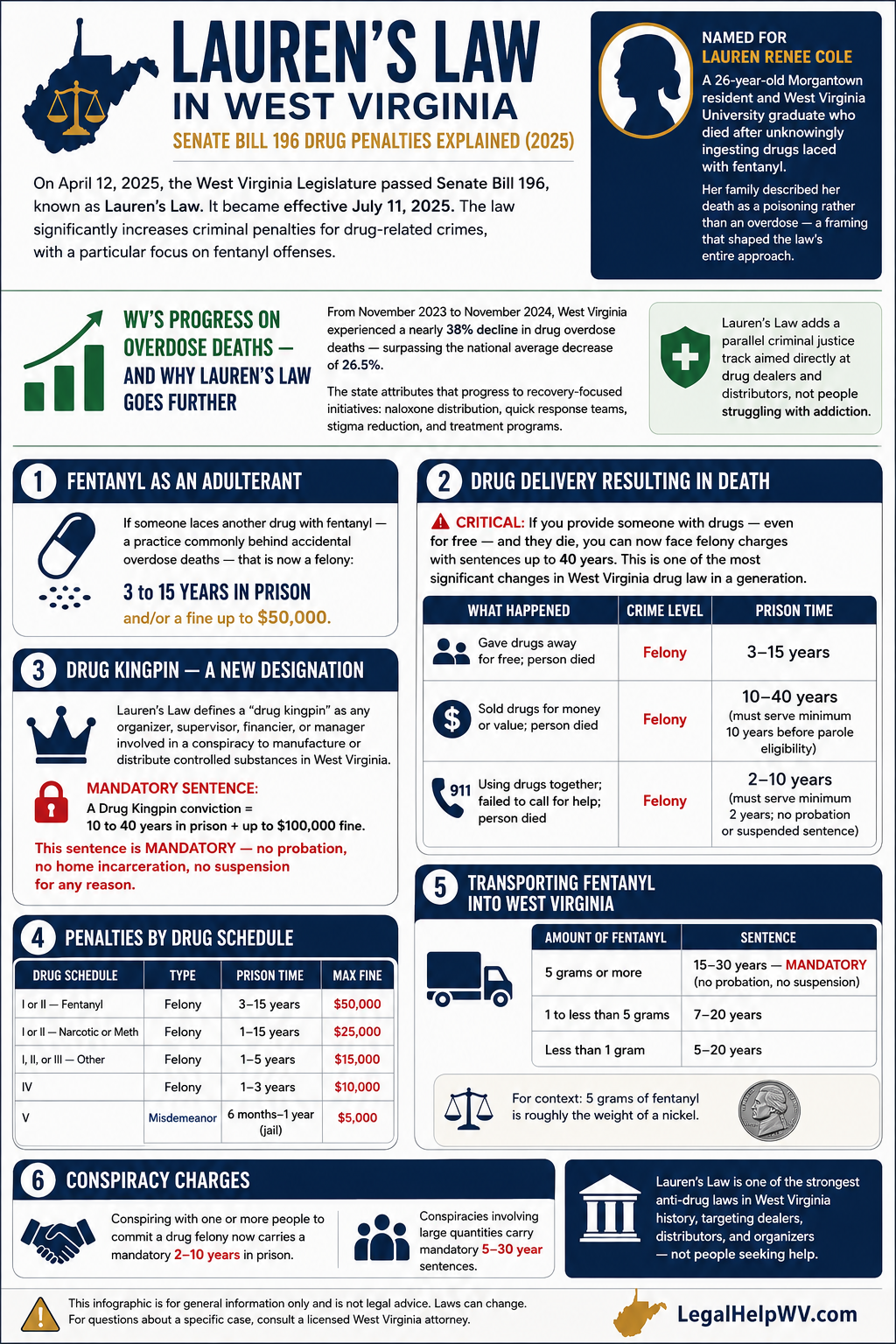
On April 12, 2025, the West Virginia Legislature passed Senate Bill 196, known as Lauren’s Law. It became effective July 11, 2025. The law significantly increases criminal penalties for drug-related crimes, with a particular focus on fentanyl offenses.
The law is named for Lauren Renee Cole, a 26-year-old Morgantown resident and West Virginia University graduate who died after unknowingly ingesting drugs laced with fentanyl. Her family described her death as a poisoning rather than an overdose — a framing that shaped the law’s entire approach.
WV’s Progress on Overdose Deaths — and Why Lauren’s Law Goes Further
From November 2023 to November 2024, West Virginia experienced a nearly 38% decline in drug overdose deaths — surpassing the national average decrease of 26.5%. The state attributes that progress to recovery-focused initiatives: naloxone distribution, quick response teams, stigma reduction, and treatment programs.
Lauren’s Law adds a parallel criminal justice track aimed directly at drug dealers and distributors, not people struggling with addiction.
Key Change #1: Fentanyl as an Adulterant
If someone laces another drug with fentanyl — a practice commonly behind accidental overdose deaths — that is now a felony: 3 to 15 years in prison and/or a fine up to $50,000.
Key Change #2: Drug Delivery Resulting in Death
⚠ Critical: If you provide someone with drugs — even for free — and they die, you can now face felony charges with sentences up to 40 years. This is one of the most significant changes in West Virginia drug law in a generation.
| What Happened | Crime Level | Prison Time |
|---|---|---|
| Gave drugs away for free; person died | Felony | 3–15 years |
| Sold drugs for money or value; person died | Felony | 10–40 years (must serve minimum 10 years before parole eligibility) |
| Using drugs together; failed to call for help; person died | Felony | 2–10 years (must serve minimum 2 years; no probation or suspended sentence) |
Key Change #3: Drug Kingpin — A New Designation
Lauren’s Law defines a “drug kingpin” as any organizer, supervisor, financier, or manager involved in a conspiracy to manufacture or distribute controlled substances in West Virginia.
🔒 Mandatory Sentence: A Drug Kingpin conviction = 10 to 40 years in prison + up to $100,000 fine. This sentence is MANDATORY — no probation, no home incarceration, no suspension for any reason.
Key Change #4: Penalties by Drug Schedule
| Drug Schedule | Type | Prison Time | Max Fine |
|---|---|---|---|
| I or II — Fentanyl | Felony | 3–15 years | $50,000 |
| I or II — Narcotic or Meth | Felony | 1–15 years | $25,000 |
| I, II, or III — Other | Felony | 1–5 years | $15,000 |
| IV | Felony | 1–3 years | $10,000 |
| V | Misdemeanor | 6 months–1 year (jail) | $5,000 |
Key Change #5: Transporting Fentanyl into West Virginia
| Amount of Fentanyl | Sentence |
|---|---|
| 5 grams or more | 15–30 years — MANDATORY (no probation, no suspension) |
| 1 to less than 5 grams | 7–20 years |
| Less than 1 gram | 5–20 years |
For context: 5 grams of fentanyl is roughly the weight of a nickel.
Key Change #6: Conspiracy Charges
Conspiring with one or more people to commit a drug felony now carries a mandatory 2–10 years in prison. Conspiracies involving large quantities carry mandatory 5–30 year sentences.
Related Posts
- Magistrate Court in West Virginia: Small Claims, Misdemeanors & What to Expect (Apr 15)
- You’ve Been Charged: A First-Timer’s Guide to the WV Criminal Court Process (Apr 18)
- How to Get a Protective Order in West Virginia: EPO vs. TEPO Explained (Apr 10)
Need Legal Help?
Facing drug charges in West Virginia? Contact a criminal defense attorney immediately.
WV State Bar Referral: 1-866-989-8227
SAMHSA Treatment Helpline: 1-800-662-4357 (free, confidential, 24/7)
This post is for general information only and is not legal advice.