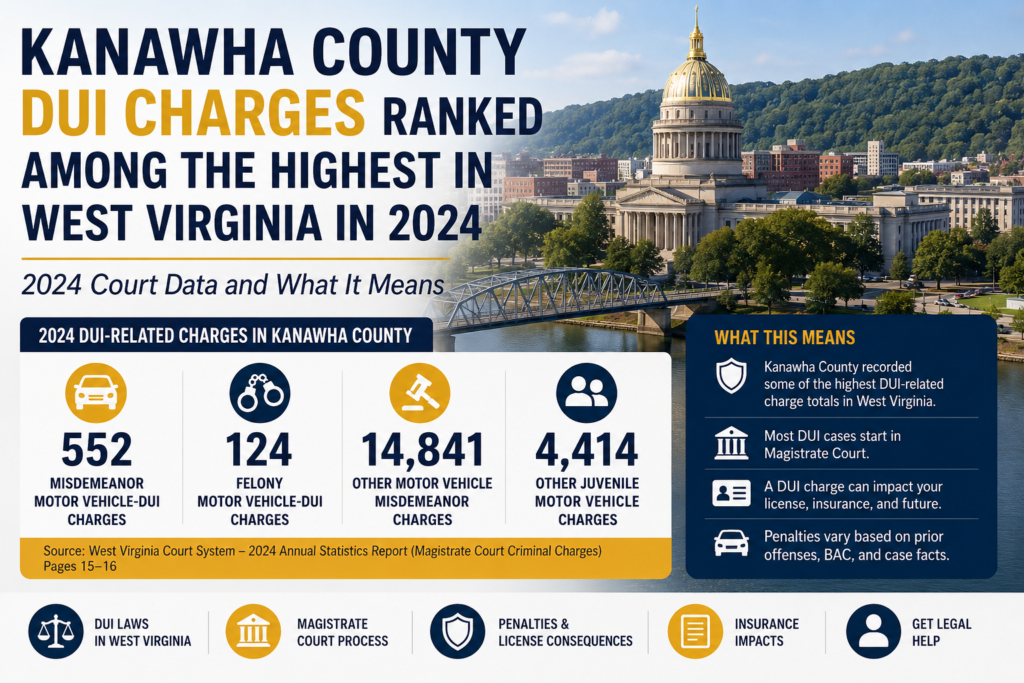
Berkeley County recorded some of the highest DUI-related motor vehicle charges in West Virginia during 2024, according to statewide court data.
Located in the Eastern Panhandle and connected to major commuter and interstate travel corridors, Berkeley County has seen rapid population growth over the past several years. That growth has also increased traffic volume, court filings, and motor vehicle-related enforcement activity.
The 2024 court statistics provide a closer look at how significant DUI-related filings remain within the county.
What the 2024 Data Shows
According to the West Virginia Court System’s 2024 Annual Statistical Report, Berkeley County recorded:
- 356 misdemeanor Motor Vehicle-DUI charges
- 170 felony Motor Vehicle-DUI charges
The county also recorded:
- 8,992 other motor vehicle misdemeanor charges
- 4,440 other juvenile motor vehicle-related charges
These filings were reported through West Virginia Magistrate Court criminal charge statistics.
Why Berkeley County’s Numbers Are High
Several factors likely contribute to Berkeley County’s high DUI-related filing totals.
Population Growth
Berkeley County has become one of the fastest-growing counties in West Virginia.
More residents typically mean:
- more vehicles
- more commuting
- more traffic stops
- more court filings
Interstate and Commuter Traffic
The county sits near major transportation routes connecting:
- West Virginia
- Maryland
- Virginia
- Washington, D.C. metro areas
That creates substantial:
- commuter traffic
- commercial traffic
- long-distance travel
- law enforcement activity
Regional Economic Growth
As the Eastern Panhandle continues growing economically, vehicle traffic and population density have increased throughout the area.
That often leads to:
- higher overall motor vehicle enforcement
- increased DUI investigations
- more criminal traffic-related filings
What Happens After a DUI Charge in Berkeley County?
Most DUI cases begin in Magistrate Court.
Magistrates handle:
- arraignments
- bond hearings
- misdemeanor proceedings
- preliminary felony examinations
West Virginia Magistrate Courts also issue warrants, conduct probable cause proceedings, and process many criminal filings statewide.
Depending on the circumstances, a DUI arrest may trigger:
- criminal penalties
- license suspension proceedings
- DMV administrative actions
- ignition interlock requirements
- insurance consequences
The outcome often depends on:
- prior DUI history
- blood alcohol level
- accident involvement
- injuries
- refusal allegations
DUI and Auto Insurance Consequences
Insurance consequences can continue long after the criminal case ends.
Drivers charged with DUI may face:
- premium increases
- policy non-renewal
- SR-22 filing requirements
- high-risk insurance classification
For some drivers, insurance costs become one of the most expensive long-term consequences of a DUI conviction.
Berkeley County Compared to Other West Virginia Counties
Berkeley County ranked among the highest counties in West Virginia for DUI-related motor vehicle filings during 2024.
Other counties with high totals included:
- Kanawha County
- Cabell County
- Monongalia County
- Raleigh County
Larger counties and high-growth areas typically generate higher filing totals because of:
- traffic volume
- commuter patterns
- population density
- interstate travel
What the Court Statistics Do — and Do Not — Show
Court filing statistics do not necessarily represent:
- convictions
- guilt
- repeat offenders
- final case outcomes
Instead, the numbers reflect charges filed within the court system during the reporting period.
Still, the data provides a useful look at statewide DUI-related court activity and long-term trends.
Final Thoughts
Berkeley County remains one of West Virginia’s busiest counties for DUI-related motor vehicle filings.
Because of its population growth, commuter traffic, and location within the Eastern Panhandle, the county continues to see substantial traffic-related court activity each year.
As WV Legal Help expands its statewide legal education coverage, we’ll continue publishing:
- county DUI statistics
- local court trends
- insurance consequence guides
- Magistrate Court explainers
- statewide legal data analysis