Category: Criminal & DUI

Plain-English guides and explanations about criminal charges and DUI cases in West Virginia, including arrests, traffic offenses, court procedures, penalties, expungement, and the criminal justice process.

  • West Virginia DUI Laws: Penalties, BAC Limits & What to Do

    A DUI charge in West Virginia is a serious matter. Even a first offense can result in jail time, fines, a suspended license, and lasting consequences for your driving record and insurance. This guide explains WV DUI law in plain English.

    WV DUI at a Glance

    BAC limit: 0.08% (adults 21+) | 0.02% (under 21) | 0.04% (commercial drivers CDL)
    Law: WV Code § 17C-5-2 | First offense: Misdemeanor | Third+: Felony

    BAC Limits in West Virginia

    • 0.08%+ — Illegal for adult drivers 21 and older
    • 0.04%+ — Illegal for commercial vehicle operators (CDL holders)
    • 0.02%+ — Illegal for drivers under 21 (zero-tolerance law)

    You can also be charged with DUI below 0.08% if other evidence shows impairment by alcohol or drugs (including prescription medications).

    First Offense DUI Penalties

    Standard (BAC below 0.15%)

    • Jail: Up to 6 months (no mandatory minimum)
    • Fine: $100 – $500
    • License revocation: 6 months
    • WV Safety and Treatment Program (WVSTP): Required
    • Ignition Interlock Device (IID): Required for reinstatement

    Aggravated DUI (BAC 0.15% or higher)

    • Jail: Mandatory minimum 24 hours
    • Fine: $200 – $1,000
    • License revocation: 45-day hard suspension + 165 days of IID-required driving

    Second Offense DUI

    • Jail: 6 months – 1 year (mandatory 6-month minimum)
    • Fine: $1,000 – $3,000
    • License revocation: 10 years
    • IID required after revocation

    Third Offense DUI (Felony)

    • Felony conviction
    • Prison: 1 – 3 years
    • Fine: $3,000 – $5,000
    • Lifetime license revocation

    The Motor Vehicle Test and Lock (Interlock) Program

    An alternative to full license revocation:

    • First offense (BAC below 0.15%): 15-day hard revocation, then 125 days with IID
    • First offense (BAC 0.15%+): 45-day hard revocation, then 270 days with IID

    Administrative License Revocation

    Your license can be revoked administratively — separate from criminal court — if you refuse a breath/blood test or exceed the BAC limit. You have the right to request a DMV hearing to contest this.

    Time Sensitive

    You typically have only 30 days from arrest to request a DMV hearing to challenge your license revocation. Miss this deadline and revocation is automatic. Contact a DUI attorney immediately.

    What to Do If Charged with DUI in WV

    1. Stay calm and exercise your right to remain silent
    2. Request an attorney before answering questions
    3. Note time, location, and all details you can remember
    4. Request a DMV hearing within 30 days to challenge revocation
    5. Contact an experienced WV DUI defense attorney immediately

    Find a DUI Lawyer Near You

    Resources

    This page is for informational purposes only and does not constitute legal advice.

  • WV DUI Administrative License Revocation: What Happens to Your License After a DUI Arrest

    Most people arrested for DUI in West Virginia focus entirely on the criminal case. What many don’t realize until it’s too late is that a separate process — the administrative license revocation — is running at the same time, on a different timeline, with a critical 30-day deadline that can’t be missed.

    Two Separate Processes, Running Simultaneously

    When you are arrested for DUI in West Virginia, two things happen at the same time:

    1. A criminal case is filed in magistrate or circuit court. This involves charges, arraignment, possible trial, and sentencing.
    2. An administrative action is initiated by the WV Division of Motor Vehicles. This is a civil process — it has nothing to do with guilt or innocence in the criminal sense. It is purely about your driving privileges.

    The critical point: you can win your criminal DUI case and still lose your license through the administrative process. They are independent of each other.

    The 30-Day Deadline: Don’t Miss It

    When you are arrested for DUI, the arresting officer should give you a form called a Notice of Revocation. From the date of that notice, you have 30 days to request an administrative hearing with the WV DMV.

    If you do not request a hearing within 30 days, your license is automatically suspended — no hearing, no second chance, no exceptions. This is the most important deadline in a DUI case and one of the first things a DUI attorney will act on.

    License Suspension Timelines by Offense Type

    Offense Administrative Suspension Interlock Requirement After
    Standard 1st DUI (BAC 0.08–0.149%) 15–45 days Not required (1st offense)
    Aggravated 1st DUI (BAC 0.15%+) 45 days 270 days mandatory
    Test refusal (1st offense) 1 year Required
    2nd DUI (within 10 years) 10 years revocation Required
    DUI causing serious injury or death 10 years revocation Required

    Note that refusing a chemical test carries a one-year suspension on its own, separate from any DUI conviction. For more on this, see our guide on refusing a DUI test in West Virginia.

    What Happens at the Administrative Hearing

    The DMV administrative hearing is not a criminal trial. There is no jury. The standard of proof is lower than in criminal court. The only question being decided is whether your driving privileges should be revoked — not whether you are guilty of a crime.

    At the hearing, the DMV will present the arresting officer’s report and the breath or blood test results. Your attorney can challenge the legality of the stop, the accuracy of the test, whether proper procedures were followed, and whether the notice requirements were met.

    Winning at the administrative hearing preserves your license. Losing means the revocation stands, regardless of what happens in the criminal case.

    The Ignition Interlock Program

    For most DUI suspensions, the path back to full driving privileges runs through the Motor Vehicle Alcohol and Drug Test and Lock Program — the ignition interlock program. You must install a certified ignition interlock device in your vehicle and drive with it for the required period before your license is fully reinstated.

    For an aggravated DUI, the interlock period is 270 days. For test refusals and repeat offenses, it can be significantly longer. The device records your BAC every time you start the car, and any violations during the interlock period can extend the requirement.

    Importantly, successful completion of the interlock program for first-time DUI offenders (with no prior DUIs) can result in dismissal of the DUI charge itself — not just license reinstatement. This is something worth discussing with an attorney early in the process.

    How This Connects to Your Criminal Case

    The administrative and criminal cases affect each other strategically even though they are separate legally. Evidence developed for one proceeding can inform the other. An attorney who handles both simultaneously is in a better position than one who focuses only on the criminal side.

    For the full picture of what you’re facing after a DUI arrest, see our complete guide to what happens after a DUI arrest in West Virginia and our overview of West Virginia DUI laws.

  • Top Divorce & DUI Lawyers in Huntington, WV

    Finding the right attorney in Huntington can make all the difference in your case. Below you will find experienced divorce and DUI defense attorneys serving Huntington and Cabell County, drawn from publicly available directories including Justia, Avvo, FindLaw, Martindale-Hubbell, and Super Lawyers.

    Important: Attorney listings are based on publicly available information. Always verify an attorney’s current license with the West Virginia State Bar (wvbar.org) before hiring. This is not a paid or sponsored directory.

    Divorce Lawyers in Huntington, WV

    Huntington’s family law attorneys handle divorce, child custody, property division, alimony, and related matters in Cabell County Family Court.

    Huntington is Cabell County’s seat and home to a competitive legal market with experienced family law attorneys. The directory links below connect you to rated, reviewed divorce attorneys serving Huntington and surrounding communities.


    DUI Defense Lawyers in Huntington, WV

    A DUI charge in West Virginia can affect your license, your job, and your future. The attorneys below have experience handling DUI cases in Cabell County courts.

    Tyler Christian Haslam

    Experience: 14 years | Focus: DUI/DWI, Criminal Defense
    Tyler Haslam is a DUI and criminal defense attorney based in Huntington with over 14 years of experience defending clients against DUI/DWI charges in Cabell County and surrounding West Virginia courts.

    Barney Law PLLC

    Focus: Criminal Defense, DUI, Personal Injury
    Barney Law PLLC provides criminal defense representation for clients in Huntington and the Tri-State area, including DUI/DWI defense.


    Related Legal Guides

    This page is for informational purposes only and does not constitute legal advice. Always verify attorney credentials with the WV State Bar before hiring.

  • Breaking Down the Numbers in Huntington’s Public Safety Dashboard

    In March 2026, the City of Huntington quietly did something it had never done before: it put its crime and public safety data online for anyone to see. The result is the Huntington Public Safety Dashboard — a free, publicly accessible tool that gives residents, business owners, and policymakers a clearer picture of what’s actually happening on the city’s streets.

    Here’s what it is, where to find it, and what the numbers are telling us.


    What Is the Huntington Public Safety Dashboard?

    The dashboard’s stated purpose is to provide “the facts you deserve to see” and “accountability you can trust” — giving residents insight into where city resources are being used and how drugs and homelessness are shaping safety and quality of life in Huntington.

    It’s built on Microsoft Power BI, an industry-standard data visualization platform, and is hosted at www.publicsafetydashboard.com. You can also access it directly through the city’s website at www.cityofhuntington.com/publicsafetydashboard.

    The dashboard was launched on March 24, 2026 — the first time Huntington has made this kind of crime data publicly available in this format.


    Where Is Huntington, and Why Does This Matter?

    Huntington sits at the southwestern tip of West Virginia, at the point where West Virginia, Ohio, and Kentucky converge along the Ohio River. With a population of around 43,000, it is the second-largest city in the state and home to Marshall University. It is also a city that has faced well-documented challenges with opioid addiction, property crime, and economic decline — issues that directly affect quality of life and business viability.

    The dashboard is significant precisely because cities like Huntington have often lacked public-facing data infrastructure. Publishing this data openly is a meaningful step toward evidence-based governance and community accountability.


    How to Use the Dashboard

    When you visit the site, you’ll see a summary homepage with key statistics broken into seven categories. Each has a “Learn More” button that opens an interactive Power BI report. Here’s what each section covers:

    Crisis Intervention Team (CIT) In 2025, the Crisis Intervention Team received more than 5 calls per day triggered by addiction, homelessness, or untreated mental illness. The deeper report shows trends over time and the breakdown of call types.

    Nuisance Crime Nuisance crimes — which include offenses like drug possession and trespassing — made up 24% of all offenses in 2025. The interactive report lets you filter by crime type, time period, and location.

    Violent Crime On average, Huntington recorded nearly one violent incident every day in 2025, with 304 total violent crimes for the year. An interactive heatmap shows where violent crimes are concentrated geographically across the city.

    Property Crime In 2025, an average of 5 residents per day became victims of property crime, largely theft of personal belongings, with 1,817 total property crimes recorded.

    Shoplifting The dashboard tracks shoplifting separately, logging 548 incidents in 2025 and estimating an average of more than $58,000 in merchandise stolen per year.

    Drug Activity Out of 649 total drug offenses in 2025, 89 involved intent to distribute. The report breaks down drug offense types and maps where incidents are occurring.

    Homelessness In 2026, officers are averaging more than 2 contacts with a person experiencing homelessness every day.


    What the Maps Show

    The interactive heatmaps are among the most valuable features of the dashboard. They allow residents to see not just citywide totals, but where specific crime types are occurring. According to WSAZ’s reporting on the launch, hotspots for violent crime include neighborhoods like Marcum Terrace, Fairfield, downtown Huntington, and West Huntington.

    For anyone running a business, managing a property, or making decisions about where to invest or locate in Huntington, these maps provide information that was previously unavailable in any public format.


    What City Officials Are Saying

    Mayor Patrick Farrell framed the dashboard as a tool for both police operations and public accountability. “I know that our police force does look at it to understand what the trends are in crime,” he said at the launch. “And that’s the most important part — not any one specific piece, but is violent crime up or is it down… where is it happening in the city? Where do we send patrols today or tomorrow? That’s how it’s being used.”

    Farrell also emphasized the dashboard’s role in moving public conversation from perception to data: “It’s about getting the information out there so people can deal with facts and not deal with perception anymore.”


    What the Numbers Don’t Tell You

    Data transparency is a starting point, not an endpoint. The dashboard shows what is happening and where, but it doesn’t explain why crime patterns exist in certain neighborhoods, whether resource allocations are shifting in response to the data, or how Huntington’s numbers compare to similar-sized cities in West Virginia or the region.

    For residents and business owners in high-crime areas, the frustration is less about access to data and more about what happens next. As one West Huntington business owner told WSAZ at the launch, “Everybody in the neighborhood wants something changed, but nothing ever is done.”

    The dashboard is a meaningful step toward accountability. Whether the data translates into measurable changes on the ground is a question worth tracking — and one the dashboard itself will help answer over time.


    The Huntington Public Safety Dashboard is free and publicly available at www.publicsafetydashboard.com. No login or registration is required.
  • Wheeling’s 2025 Crime Report: What the Numbers Mean for Wheeling WV Residents

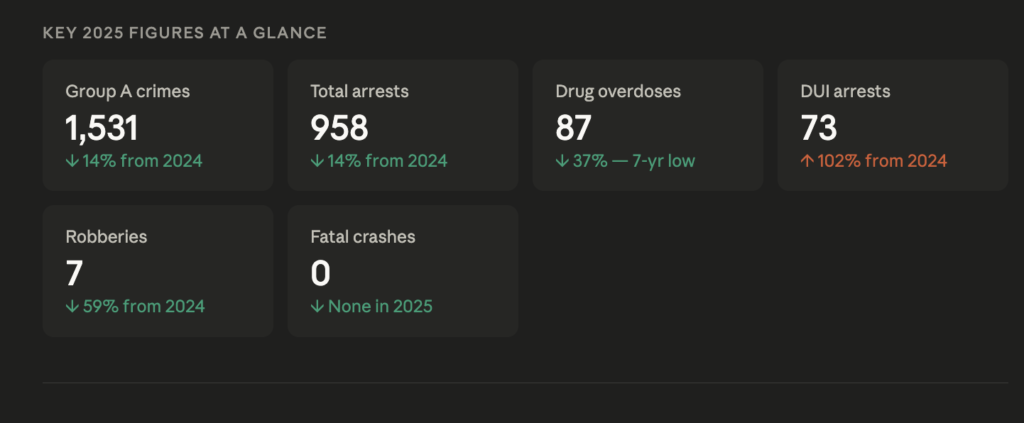
    The Wheeling Police Department released its 2025 annual crime statistics in January 2026, and the headline numbers are striking. Crime is down — significantly, and across the board. But behind the encouraging figures are legal trends worth paying close attention to, from DUI enforcement spikes to evolving drug case patterns.


    The story behind the numbers

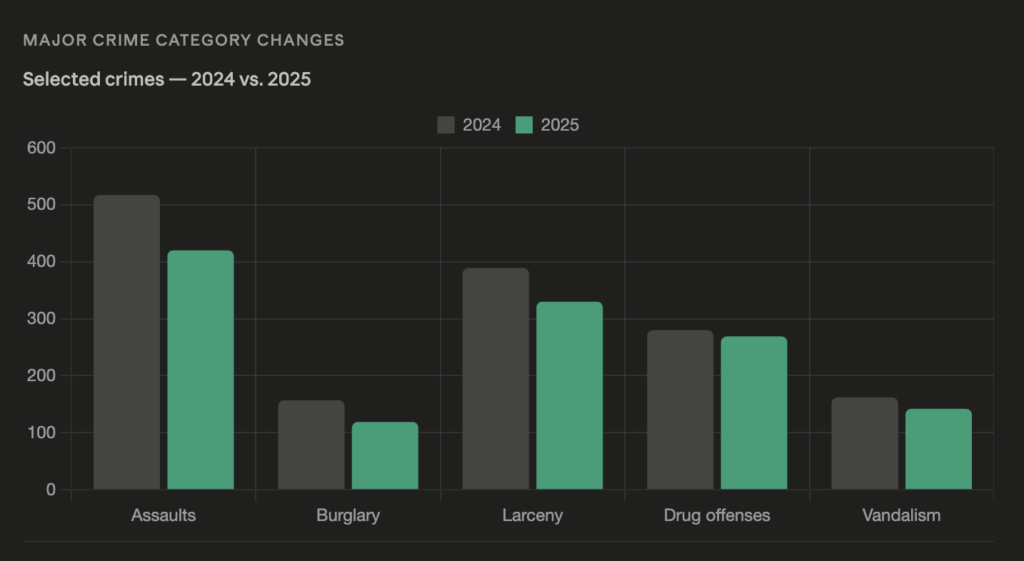
    Assaults dropped 19%, burglaries dropped 24%. These are meaningful declines for Ohioans-on-Ohio County residents whose property or personal safety was the focus of criminal activity. Fewer incidents mean fewer arrests — but it also means that when charges are filed, they tend to carry more prosecutorial weight. If you or a family member is facing an assault or burglary charge in Wheeling, the legal environment remains serious despite the lower overall numbers.

    Motor vehicle theft plummeted 58%, robbery fell 59%. Violent and opportunistic property crimes saw some of the sharpest year-over-year declines in recent memory. For residents who have been victims of these crimes, this trend is encouraging — but those facing charges related to vehicle theft or robbery should understand that these offenses carry serious felony consequences under WV law regardless of overall crime trends.

    Important legal note: A declining crime rate does not reduce the penalties for individual offenses. West Virginia prosecutors still pursue robbery, burglary, and assault charges aggressively. If you have been charged with any of these offenses in Wheeling or surrounding areas, speaking with a qualified WV criminal defense attorney as early as possible is essential.
    DUI enforcement doubled — what that means for you

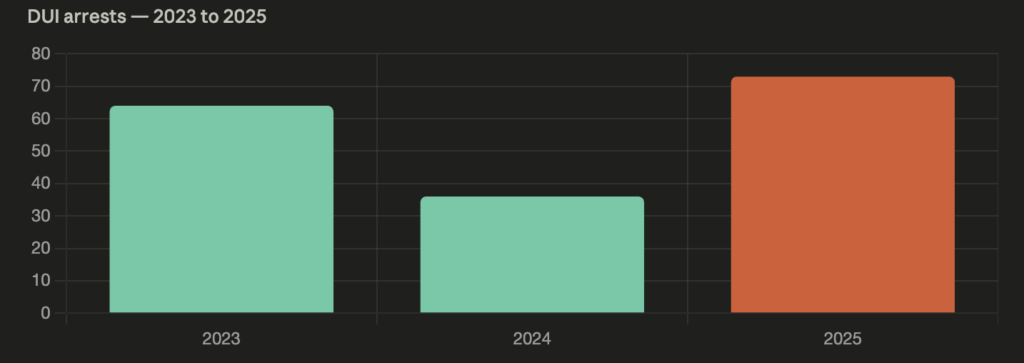
    Perhaps the most legally significant data point for everyday residents: DUI arrests jumped 102%, from 36 in 2024 to 73 in 2025. Traffic citations overall were down 22%, suggesting police shifted emphasis away from routine stops toward targeted DUI enforcement. No fatal crashes occurred in 2025 — a remarkable milestone — but the dramatic increase in DUI arrests signals that law enforcement is actively prioritizing impaired driving.

    Under West Virginia law, a first-offense DUI can result in license revocation, mandatory alcohol education programs, fines, and even jail time. A second offense carries mandatory minimum jail sentences. The doubling of DUI arrests in Wheeling means more West Virginians will be navigating the state’s DUI legal process in 2026 — often without fully understanding their rights or options.


    Drug offenses and overdose trends

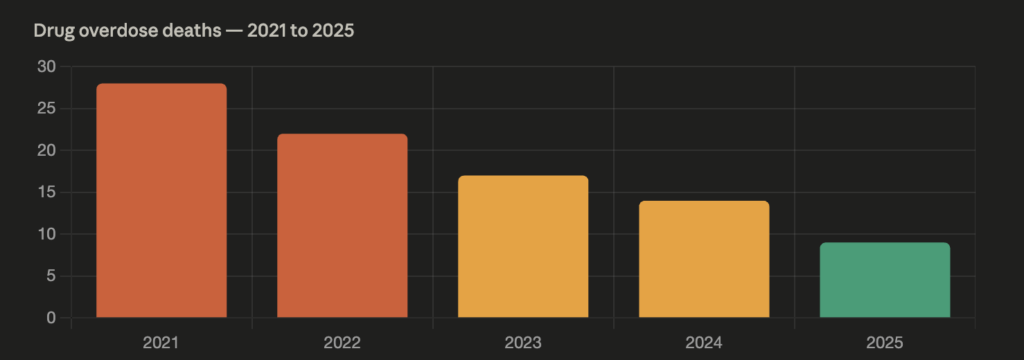
    Drug overdoses fell to 87 cases — the lowest total in a decade — and overdose deaths dropped to just 9, down from a peak of 28 five years ago. This is a public health milestone for a region that has faced severe opioid crisis pressures. Drug offense arrests declined 4%, a modest reduction that suggests enforcement activity is still substantial even as overdose outcomes improve.

    For individuals facing drug charges in West Virginia, the legal landscape includes both criminal penalties and, in many cases, diversion program opportunities. WV courts have expanded access to drug courts and treatment-based sentencing in recent years — paths that may be available depending on the specifics of a case. An experienced WV criminal defense attorney can help evaluate whether diversion is a realistic option.

    What this report means for West Virginia residents facing charges

    Fewer arrests, higher stakes per case. With overall arrests down 14%, each case that does move forward tends to receive more prosecutorial attention. Early legal representation matters.

    DUI enforcement is a priority in 2025–2026. The 102% spike in DUI arrests signals a sustained enforcement push. If you’ve been charged, time-sensitive steps — including protecting your license — require prompt action.

    Drug charges may come with diversion options. Declining overdose deaths reflect expanded treatment pathways. A defense attorney can help determine if drug court or diversion applies to your situation.

    Crime trends don’t affect individual sentencing. Even in a year of declining crime, WV law sets mandatory minimums for felonies. Understanding the charges against you is step one.