Category: DUI

Plain-English guides and explanations about DUI charges in West Virginia, including arrests, penalties, license suspension, court procedures, and DUI-related statistics.

  • West Virginia DUI Laws: Penalties, BAC Limits & What to Do

    A DUI charge in West Virginia is a serious matter. Even a first offense can result in jail time, fines, a suspended license, and lasting consequences for your driving record and insurance. This guide explains WV DUI law in plain English.

    WV DUI at a Glance

    BAC limit: 0.08% (adults 21+) | 0.02% (under 21) | 0.04% (commercial drivers CDL)
    Law: WV Code § 17C-5-2 | First offense: Misdemeanor | Third+: Felony

    BAC Limits in West Virginia

    • 0.08%+ — Illegal for adult drivers 21 and older
    • 0.04%+ — Illegal for commercial vehicle operators (CDL holders)
    • 0.02%+ — Illegal for drivers under 21 (zero-tolerance law)

    You can also be charged with DUI below 0.08% if other evidence shows impairment by alcohol or drugs (including prescription medications).

    First Offense DUI Penalties

    Standard (BAC below 0.15%)

    • Jail: Up to 6 months (no mandatory minimum)
    • Fine: $100 – $500
    • License revocation: 6 months
    • WV Safety and Treatment Program (WVSTP): Required
    • Ignition Interlock Device (IID): Required for reinstatement

    Aggravated DUI (BAC 0.15% or higher)

    • Jail: Mandatory minimum 24 hours
    • Fine: $200 – $1,000
    • License revocation: 45-day hard suspension + 165 days of IID-required driving

    Second Offense DUI

    • Jail: 6 months – 1 year (mandatory 6-month minimum)
    • Fine: $1,000 – $3,000
    • License revocation: 10 years
    • IID required after revocation

    Third Offense DUI (Felony)

    • Felony conviction
    • Prison: 1 – 3 years
    • Fine: $3,000 – $5,000
    • Lifetime license revocation

    The Motor Vehicle Test and Lock (Interlock) Program

    An alternative to full license revocation:

    • First offense (BAC below 0.15%): 15-day hard revocation, then 125 days with IID
    • First offense (BAC 0.15%+): 45-day hard revocation, then 270 days with IID

    Administrative License Revocation

    Your license can be revoked administratively — separate from criminal court — if you refuse a breath/blood test or exceed the BAC limit. You have the right to request a DMV hearing to contest this.

    Time Sensitive

    You typically have only 30 days from arrest to request a DMV hearing to challenge your license revocation. Miss this deadline and revocation is automatic. Contact a DUI attorney immediately.

    What to Do If Charged with DUI in WV

    1. Stay calm and exercise your right to remain silent
    2. Request an attorney before answering questions
    3. Note time, location, and all details you can remember
    4. Request a DMV hearing within 30 days to challenge revocation
    5. Contact an experienced WV DUI defense attorney immediately

    Find a DUI Lawyer Near You

    Resources

    This page is for informational purposes only and does not constitute legal advice.
  • WV DUI Administrative License Revocation: What Happens to Your License After a DUI Arrest

    Most people arrested for DUI in West Virginia focus entirely on the criminal case. What many don’t realize until it’s too late is that a separate process — the administrative license revocation — is running at the same time, on a different timeline, with a critical 30-day deadline that can’t be missed.

    Two Separate Processes, Running Simultaneously

    When you are arrested for DUI in West Virginia, two things happen at the same time:

    1. A criminal case is filed in magistrate or circuit court. This involves charges, arraignment, possible trial, and sentencing.
    2. An administrative action is initiated by the WV Division of Motor Vehicles. This is a civil process — it has nothing to do with guilt or innocence in the criminal sense. It is purely about your driving privileges.

    The critical point: you can win your criminal DUI case and still lose your license through the administrative process. They are independent of each other.

    The 30-Day Deadline: Don’t Miss It

    When you are arrested for DUI, the arresting officer should give you a form called a Notice of Revocation. From the date of that notice, you have 30 days to request an administrative hearing with the WV DMV.

    If you do not request a hearing within 30 days, your license is automatically suspended — no hearing, no second chance, no exceptions. This is the most important deadline in a DUI case and one of the first things a DUI attorney will act on.

    License Suspension Timelines by Offense Type

    Offense Administrative Suspension Interlock Requirement After
    Standard 1st DUI (BAC 0.08–0.149%) 15–45 days Not required (1st offense)
    Aggravated 1st DUI (BAC 0.15%+) 45 days 270 days mandatory
    Test refusal (1st offense) 1 year Required
    2nd DUI (within 10 years) 10 years revocation Required
    DUI causing serious injury or death 10 years revocation Required

    Note that refusing a chemical test carries a one-year suspension on its own, separate from any DUI conviction. For more on this, see our guide on refusing a DUI test in West Virginia.

    What Happens at the Administrative Hearing

    The DMV administrative hearing is not a criminal trial. There is no jury. The standard of proof is lower than in criminal court. The only question being decided is whether your driving privileges should be revoked — not whether you are guilty of a crime.

    At the hearing, the DMV will present the arresting officer’s report and the breath or blood test results. Your attorney can challenge the legality of the stop, the accuracy of the test, whether proper procedures were followed, and whether the notice requirements were met.

    Winning at the administrative hearing preserves your license. Losing means the revocation stands, regardless of what happens in the criminal case.

    The Ignition Interlock Program

    For most DUI suspensions, the path back to full driving privileges runs through the Motor Vehicle Alcohol and Drug Test and Lock Program — the ignition interlock program. You must install a certified ignition interlock device in your vehicle and drive with it for the required period before your license is fully reinstated.

    For an aggravated DUI, the interlock period is 270 days. For test refusals and repeat offenses, it can be significantly longer. The device records your BAC every time you start the car, and any violations during the interlock period can extend the requirement.

    Importantly, successful completion of the interlock program for first-time DUI offenders (with no prior DUIs) can result in dismissal of the DUI charge itself — not just license reinstatement. This is something worth discussing with an attorney early in the process.

    How This Connects to Your Criminal Case

    The administrative and criminal cases affect each other strategically even though they are separate legally. Evidence developed for one proceeding can inform the other. An attorney who handles both simultaneously is in a better position than one who focuses only on the criminal side.

    For the full picture of what you’re facing after a DUI arrest, see our complete guide to what happens after a DUI arrest in West Virginia and our overview of West Virginia DUI laws.

  • Top Divorce & DUI Lawyers in Huntington, WV

    Finding the right attorney in Huntington can make all the difference in your case. Below you will find experienced divorce and DUI defense attorneys serving Huntington and Cabell County, drawn from publicly available directories including Justia, Avvo, FindLaw, Martindale-Hubbell, and Super Lawyers.

    Important: Attorney listings are based on publicly available information. Always verify an attorney’s current license with the West Virginia State Bar (wvbar.org) before hiring. This is not a paid or sponsored directory.

    Divorce Lawyers in Huntington, WV

    Huntington’s family law attorneys handle divorce, child custody, property division, alimony, and related matters in Cabell County Family Court.

    Huntington is Cabell County’s seat and home to a competitive legal market with experienced family law attorneys. The directory links below connect you to rated, reviewed divorce attorneys serving Huntington and surrounding communities.


    DUI Defense Lawyers in Huntington, WV

    A DUI charge in West Virginia can affect your license, your job, and your future. The attorneys below have experience handling DUI cases in Cabell County courts.

    Tyler Christian Haslam

    Experience: 14 years | Focus: DUI/DWI, Criminal Defense
    Tyler Haslam is a DUI and criminal defense attorney based in Huntington with over 14 years of experience defending clients against DUI/DWI charges in Cabell County and surrounding West Virginia courts.

    Barney Law PLLC

    Focus: Criminal Defense, DUI, Personal Injury
    Barney Law PLLC provides criminal defense representation for clients in Huntington and the Tri-State area, including DUI/DWI defense.


    Related Legal Guides

    This page is for informational purposes only and does not constitute legal advice. Always verify attorney credentials with the WV State Bar before hiring.

  • Berkeley County DUI Charges Ranked Among the Highest in West Virginia in 2024

    Berkeley County recorded some of the highest DUI-related motor vehicle charges in West Virginia during 2024, according to statewide court data.

    Located in the Eastern Panhandle and connected to major commuter and interstate travel corridors, Berkeley County has seen rapid population growth over the past several years. That growth has also increased traffic volume, court filings, and motor vehicle-related enforcement activity.

    The 2024 court statistics provide a closer look at how significant DUI-related filings remain within the county.


    What the 2024 Data Shows

    According to the West Virginia Court System’s 2024 Annual Statistical Report, Berkeley County recorded:

    • 356 misdemeanor Motor Vehicle-DUI charges
    • 170 felony Motor Vehicle-DUI charges

    The county also recorded:

    • 8,992 other motor vehicle misdemeanor charges
    • 4,440 other juvenile motor vehicle-related charges

    These filings were reported through West Virginia Magistrate Court criminal charge statistics.


    Why Berkeley County’s Numbers Are High

    Several factors likely contribute to Berkeley County’s high DUI-related filing totals.

    Population Growth

    Berkeley County has become one of the fastest-growing counties in West Virginia.

    More residents typically mean:

    • more vehicles
    • more commuting
    • more traffic stops
    • more court filings

    Interstate and Commuter Traffic

    The county sits near major transportation routes connecting:

    • West Virginia
    • Maryland
    • Virginia
    • Washington, D.C. metro areas

    That creates substantial:

    • commuter traffic
    • commercial traffic
    • long-distance travel
    • law enforcement activity

    Regional Economic Growth

    As the Eastern Panhandle continues growing economically, vehicle traffic and population density have increased throughout the area.

    That often leads to:

    • higher overall motor vehicle enforcement
    • increased DUI investigations
    • more criminal traffic-related filings

    What Happens After a DUI Charge in Berkeley County?

    Most DUI cases begin in Magistrate Court.

    Magistrates handle:

    • arraignments
    • bond hearings
    • misdemeanor proceedings
    • preliminary felony examinations

    West Virginia Magistrate Courts also issue warrants, conduct probable cause proceedings, and process many criminal filings statewide.

    Depending on the circumstances, a DUI arrest may trigger:

    • criminal penalties
    • license suspension proceedings
    • DMV administrative actions
    • ignition interlock requirements
    • insurance consequences

    The outcome often depends on:

    • prior DUI history
    • blood alcohol level
    • accident involvement
    • injuries
    • refusal allegations

    DUI and Auto Insurance Consequences

    Insurance consequences can continue long after the criminal case ends.

    Drivers charged with DUI may face:

    • premium increases
    • policy non-renewal
    • SR-22 filing requirements
    • high-risk insurance classification

    For some drivers, insurance costs become one of the most expensive long-term consequences of a DUI conviction.


    Berkeley County Compared to Other West Virginia Counties

    Berkeley County ranked among the highest counties in West Virginia for DUI-related motor vehicle filings during 2024.

    Other counties with high totals included:

    • Kanawha County
    • Cabell County
    • Monongalia County
    • Raleigh County

    Larger counties and high-growth areas typically generate higher filing totals because of:

    • traffic volume
    • commuter patterns
    • population density
    • interstate travel

    What the Court Statistics Do — and Do Not — Show

    Court filing statistics do not necessarily represent:

    • convictions
    • guilt
    • repeat offenders
    • final case outcomes

    Instead, the numbers reflect charges filed within the court system during the reporting period.

    Still, the data provides a useful look at statewide DUI-related court activity and long-term trends.


    Final Thoughts

    Berkeley County remains one of West Virginia’s busiest counties for DUI-related motor vehicle filings.

    Because of its population growth, commuter traffic, and location within the Eastern Panhandle, the county continues to see substantial traffic-related court activity each year.

    As WV Legal Help expands its statewide legal education coverage, we’ll continue publishing:

    • county DUI statistics
    • local court trends
    • insurance consequence guides
    • Magistrate Court explainers
    • statewide legal data analysis
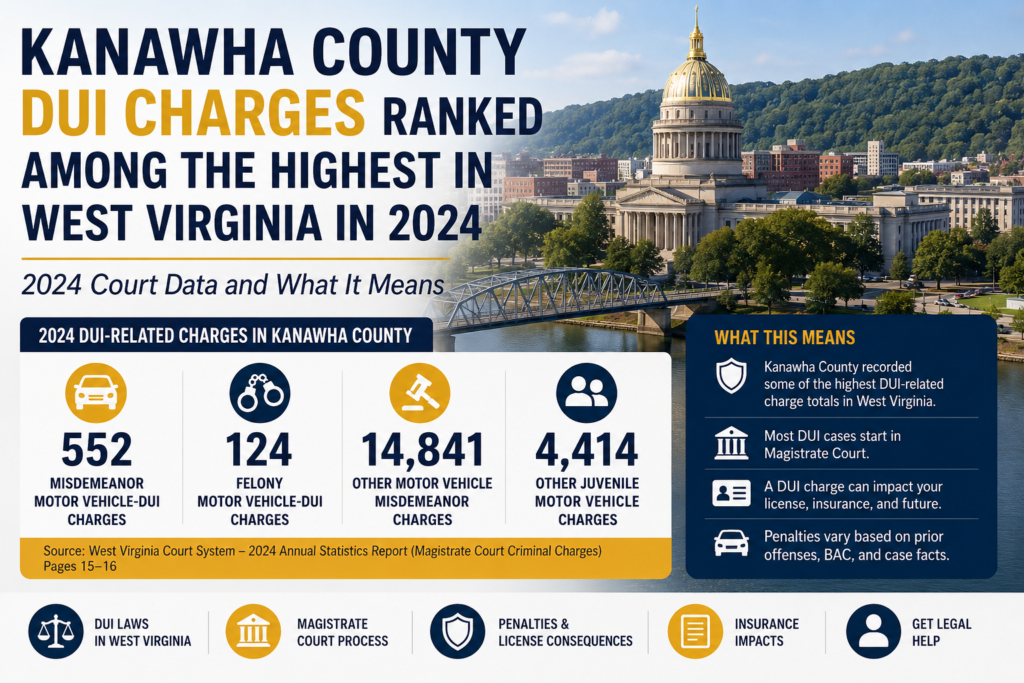
  • Kanawha County DUI Charges Ranked Among the Highest in West Virginia in 2024

    Kanawha County recorded some of the highest DUI-related motor vehicle charges in West Virginia during 2024, according to data published by the West Virginia court system.

    Because Kanawha County is West Virginia’s largest county by population and includes Charleston, major interstate traffic corridors, and heavy commuter activity, it consistently ranks near the top of statewide criminal filing statistics.

    The 2024 numbers help show both the scale of DUI-related cases and how often Magistrate Courts handle motor vehicle offenses across the county.


    What the 2024 Data Shows

    According to the West Virginia Court System’s 2024 Annual Statistics Report, Kanawha County recorded:

    • 552 misdemeanor Motor Vehicle-DUI charges
    • 124 felony Motor Vehicle-DUI charges

    Kanawha County also recorded:

    • 14,841 other motor vehicle misdemeanor charges
    • 4,414 other juvenile motor vehicle-related charges

    These numbers came from Magistrate Court criminal charge filings reported statewide.


    Why Kanawha County’s Numbers Are So High

    Several factors likely contribute to Kanawha County’s DUI-related filing volume:

    Population

    Kanawha County is the most populous county in West Virginia.

    More residents and more drivers naturally create more traffic-related court filings.


    Interstate Traffic

    Major highways and interstate corridors run through the Charleston area, increasing:

    • commuter traffic
    • commercial vehicle traffic
    • tourism-related driving
    • law enforcement activity

    Charleston Metro Activity

    As the state capital and a regional employment center, Charleston generates:

    • nightlife traffic
    • event traffic
    • commuting patterns
    • higher daily vehicle volume

    What Happens After a DUI Charge in Kanawha County?

    Most DUI cases begin in Magistrate Court.

    Magistrates handle:

    • arraignments
    • bond hearings
    • misdemeanor proceedings
    • preliminary hearings in felony cases

    West Virginia Magistrate Courts also issue warrants, set bail, and process many criminal complaints statewide.

    A DUI arrest may trigger:

    • criminal court proceedings
    • DMV administrative consequences
    • insurance increases
    • possible license suspension
    • ignition interlock requirements

    The exact process depends on:

    • prior offenses
    • blood alcohol level
    • injuries
    • refusal allegations
    • whether the case involves felony enhancements

    DUI and Auto Insurance Consequences

    A DUI conviction can significantly affect auto insurance.

    Drivers may face:

    • premium increases
    • policy cancellation
    • high-risk insurance classification
    • SR-22 filing requirements

    Insurance consequences sometimes last years beyond the court case itself.


    Kanawha County Compared to Other Counties

    Kanawha County ranked among the highest counties in West Virginia for DUI-related motor vehicle filings in 2024.

    Other counties with high totals included:

    • Cabell County
    • Berkeley County
    • Monongalia County
    • Raleigh County

    Larger counties typically report higher overall filing totals because of:

    • population size
    • highway systems
    • traffic density
    • regional economic activity

    What the Statistics Do — and Do Not — Mean

    Court filing data does not necessarily measure:

    • convictions
    • guilt
    • repeat offenders
    • exact arrest totals

    Instead, the numbers reflect charges filed in the court system during the reporting year.

    Still, the data provides a useful look at statewide DUI-related court activity and long-term trends.


    Final Thoughts

    Kanawha County continues to be one of West Virginia’s busiest counties for DUI-related court filings.

    Because the county sits at the center of the state’s population, government activity, and transportation network, DUI-related traffic enforcement and court activity remain significant parts of the local legal system.

    As WV Legal Help expands its DUI and insurance coverage, we’ll continue publishing:

    • county-level DUI statistics
    • court process guides
    • insurance consequences
    • Magistrate Court explainers
    • statewide legal trend analysis