Tag: judgment collection

  • Why Winning in Court and Collecting Money Are Two Different Things

    For many people, the biggest surprise in civil court is not whether they can win. It is what happens after they win.

    A judgment feels final. In one sense, it is. The court has decided that one party owes money or must take some action. But in many cases, judgment is only the beginning of the collection process.

    Why Winning Is Not the End

    The court can decide that money is owed. But collection still depends on real-world factors like:

    • whether the debtor has wages,
    • whether the debtor has money in the bank,
    • whether the debtor owns property,
    • whether the debtor operates through a business entity, and
    • whether the creditor takes the right steps to enforce the judgment.

    The legal system may give the winning party the right to pursue collection. It usually does not automatically put money in that person’s hand.

    Why Collection Can Feel Unfair

    Many people walk away from court assuming the system will now make them whole. That is not always how it works. A judgment may confirm that someone owes money, but the creditor may still need to locate assets, follow procedures, and decide whether collection is worth the time and cost.

    That gap can make the system feel frustrating, especially when the losing party seems to stay one step ahead.

    The Second Battle

    Collection can involve persistence, timing, investigation, and strategy. Some debtors pay promptly. Others are hard to collect from because they have no reachable assets, their income is limited, or their business structure complicates enforcement.

    That is why winning a lawsuit and collecting money are often two separate battles. The first battle is proving the case. The second battle is turning the judgment into payment.

    What People Should Understand Early

    If you are thinking about litigation, it is not enough to ask whether you can win. You should also ask:

    • Will the other side be collectible?
    • Do they have wages, assets, bank accounts, or property?
    • Are they operating through one entity or several?
    • Is there a realistic path to payment?
    • If I win, what happens next?

    These questions do not mean you should avoid court. They mean you should understand the practical side of litigation before spending time and money on a lawsuit.

    How This Connects to Judgments and Liens

    A judgment gives the winning party legal rights. A lien may create additional leverage by connecting the debt to property. That is why it helps to understand the difference between a judgment and a lien.

    It also helps to understand timing. A judgment that sits untouched for years may become harder to enforce in practice. For more on that issue, read How Long Is a Judgment Good For in West Virginia?.

    The Takeaway

    Winning matters. But winning alone may not get the result you expect. In civil disputes, the practical question is often not just Can I get a judgment? It is Can I ever turn that judgment into money?

    This article is general legal information, not legal advice. For guidance about a specific civil case or judgment, speak with a licensed West Virginia attorney.
  • Judgment vs. Lien in West Virginia: What Is the Difference?

    People often use the words judgment and lien as if they mean the same thing. They do not.

    The difference matters because a judgment may say that money is owed, while a lien may give the creditor a claim against property. Those are related concepts, but they are not identical.

    What Is a Judgment?

    A judgment is a court decision stating that one party owes money to another. It confirms legal liability. In plain English, it means the court has said: this debt is real.

    But a judgment does not necessarily mean the creditor has been paid. It also does not automatically mean the debtor’s property has been sold, frozen, or transferred. After judgment, collection may still require additional steps.

    What Is a Lien?

    A lien is different. A lien is a legal claim that may attach to property. It can give a creditor leverage because the lien may affect the debtor’s ability to sell, refinance, or transfer certain property without dealing with the debt.

    That is why someone can say, “There was a judgment, but there was never a lien,” and be describing a meaningful distinction.

    Why the Difference Matters

    A judgment gives the creditor legal rights. A lien may strengthen those rights by connecting them to property. Without that extra step, a judgment may remain just a court paper unless the creditor uses some other collection tool.

    That distinction can become important when people are trying to figure out why a creditor did or did not get paid. A creditor with only a judgment may have fewer practical tools than a creditor who also took steps to create or perfect a lien.

    Common Misunderstanding

    Many people assume that once a judgment is entered, property is automatically tied up forever. Real life is usually more complicated. Whether a lien exists, whether it was properly created, whether it attached to the right property, and whether it remains effective can all be separate questions.

    How This Fits Into Collection

    If you are trying to understand why a judgment was not collected, the judgment-lien distinction matters. The creditor may have won the lawsuit but failed to take later enforcement steps. The debtor may not own property. Or the creditor may have had rights on paper but little leverage in practice.

    This also helps explain why old cases sometimes feel confusing. Someone may remember the lawsuit and the judgment, but never remember any active collection pressure afterward.

    Keep Reading

    To understand the broader collection picture, read Can Someone Avoid Paying a Judgment? and How Long Is a Judgment Good For in West Virginia?.

    The Bottom Line

    A judgment says who won and what is owed. A lien may give the creditor a claim against property. If you are trying to collect money, defend against collection, or understand an old case, that difference can be critical.

    This article is general legal information, not legal advice. For guidance about a specific judgment or lien, speak with a licensed West Virginia attorney.

  • Multiple LLCs and Judgment Collection in West Virginia: Red Flag or Normal Business Practice?

    It is common for a business owner to use more than one LLC. In many situations, that is ordinary business planning. Separate entities may be used to hold different assets, manage risk, or operate different lines of business.

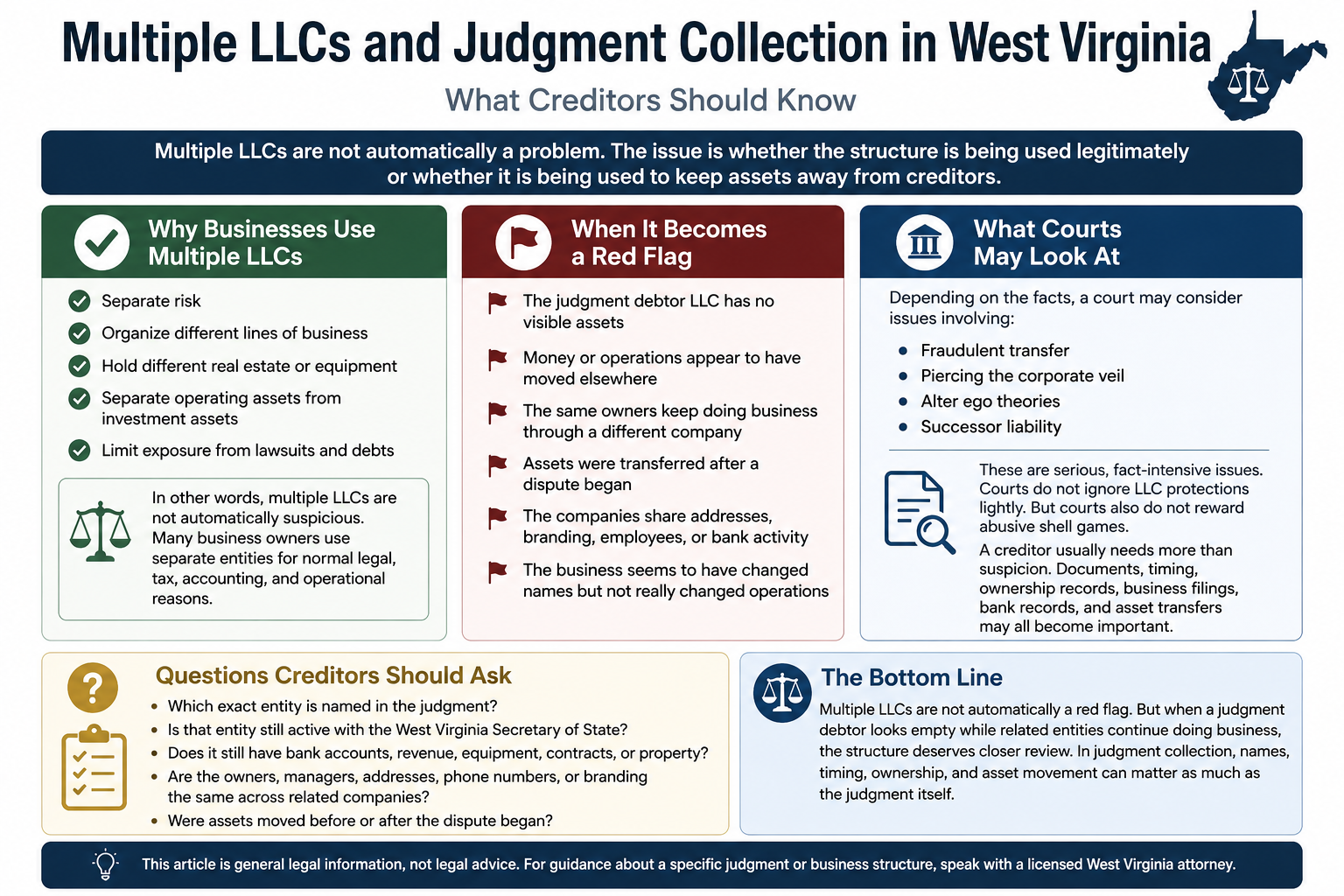
    But if you are trying to collect on a judgment, multiple LLCs can raise difficult questions. The issue is not simply whether there are several entities. The issue is whether the structure is being used legitimately or whether it is being used to keep assets away from creditors.

    Multiple LLCs WV

    Why Businesses Use Multiple LLCs

    Separate entities are often created to:

    • separate risk
    • organize different lines of business
    • hold different real estate or equipment
    • separate operating assets from investment assets, or
    • limit exposure from lawsuits and debts

    In other words, multiple LLCs are not automatically suspicious. Many business owners use separate entities for normal legal, tax, accounting, and operational reasons.

    When It Becomes a Red Flag

    The concern grows when the entity that lost the lawsuit appears empty while related entities continue operating. Red flags may include:

    • the judgment debtor LLC has no visible assets,
    • money or operations appear to have moved elsewhere,
    • the same owners keep doing business through a different company,
    • assets were transferred after a dispute began,
    • the companies share addresses, branding, employees, or bank activity, or
    • the business seems to have changed names but not really changed operations.

    That is when people start wondering whether the structure was used to make the business judgment-proof.

    What Courts May Look At

    Depending on the facts, a court may consider issues involving fraudulent transfer, piercing the corporate veil, alter ego theories, or successor liability. These are serious, fact-intensive issues. Courts do not ignore LLC protections lightly. But courts also do not reward abusive shell games.

    The details matter. A creditor usually needs more than suspicion. Documents, timing, ownership records, business filings, bank records, and asset transfers may all become important.

    Questions Creditors Should Ask

    If you are trying to understand whether multiple LLCs matter, start with practical questions:

    • Which exact entity is named in the judgment?
    • Is that entity still active with the West Virginia Secretary of State?
    • Does it still have bank accounts, revenue, equipment, contracts, or property?
    • Are the owners, managers, addresses, phone numbers, or branding the same across related companies?
    • Were assets moved before or after the dispute began?

    Those details may matter more than the number of LLCs alone.

    Why This Matters in Collection

    People often assume winning a lawsuit means the hard part is over. But sometimes the real problem begins after judgment, especially when the debtor operates through layered business entities.

    That is one reason many people start with the broader question: Can someone avoid paying a judgment? You may also want to understand the difference between a judgment itself and a property claim by reading Judgment vs. Lien in West Virginia.

    The Bottom Line

    Multiple LLCs are not automatically a red flag. But when a judgment debtor looks empty while related entities continue doing business, the structure deserves closer review. In judgment collection, names, timing, ownership, and asset movement can matter as much as the judgment itself.

    This article is general legal information, not legal advice. For guidance about a specific judgment or business structure, speak with a licensed West Virginia attorney.

  • How Long Is a Judgment Good For in West Virginia?

    One of the most practical questions in any collection dispute is simple: how long is a judgment good for in West Virginia?

    The answer matters because a judgment does not stay equally powerful forever. Deadlines, liens, renewals, and enforcement steps can affect whether a judgment still has real leverage. A judgment that sits untouched for years may still exist on paper, but it may be much harder to turn into money.

    What a Judgment Actually Does

    A judgment is a court order saying that one party owes money to another. It confirms legal liability. But a judgment is not the same thing as payment. After a judgment is entered, the winning party may still need to take additional steps to collect.

    That is why the age of a judgment matters. A fresh judgment may give a creditor more practical options. An old judgment may require a closer look at the court record, any liens, and whether enforcement activity continued over time.

    Why Age Matters

    When a judgment becomes old, several problems can develop:

    • records may be harder to track,
    • the debtor’s financial situation may have changed,
    • assets may have been sold, transferred, or refinanced,
    • collection efforts may have stopped, and
    • important deadlines may have passed.

    None of those facts automatically means the judgment is gone. But they do mean an old judgment should not be treated the same way as a recent one.

    Judgment Rights vs. Real-World Leverage

    There is a difference between having a legal right and having practical collection power. A creditor may have a judgment, but still struggle to collect if the debtor has no reachable wages, bank accounts, real estate, or business assets.

    The issue becomes even more complicated when no lien was created, when the debtor moved assets, or when a business debtor operated through multiple entities. In those situations, the creditor may need more than the judgment itself.

    If You Have Heard Nothing for Years

    Long periods of silence can mean different things. The creditor may have given up. The debtor may have had no reachable assets. The judgment may never have been actively enforced. Or important follow-up steps may have been missed.

    But silence does not always mean the judgment disappeared. If you discover an old judgment, the safest move is to check the docket, look for recorded liens, and find out whether any collection activity happened after the judgment was entered.

    Related Questions Worth Understanding

    People asking about timing are often also trying to understand how collection works. Two related issues are especially important:

    The Bottom Line

    If a judgment is recent, there may be meaningful collection options. If it is old, timing questions become central. Either way, the key point is this: do not assume an old judgment still works the same way a fresh one does.

    This article is general legal information, not legal advice. For guidance about a specific judgment, speak with a licensed West Virginia attorney.