If you are filing West Virginia state income tax for the first time, or even the tenth time, the process can still feel confusing. Many taxpayers are not sure whether they need to file, which forms apply, what documents they need, or what happens if something is filed incorrectly.
The good news is that most West Virginia tax filing problems come from a handful of common issues: using the wrong form, misunderstanding residency status, missing withholding information, overlooking deadlines, or failing to keep organized records.
This guide breaks the process into practical sections so taxpayers can better understand how West Virginia state income tax filing works, what documents matter, which forms are commonly used, how deadlines operate, and how to reduce the risk of penalties or notices.
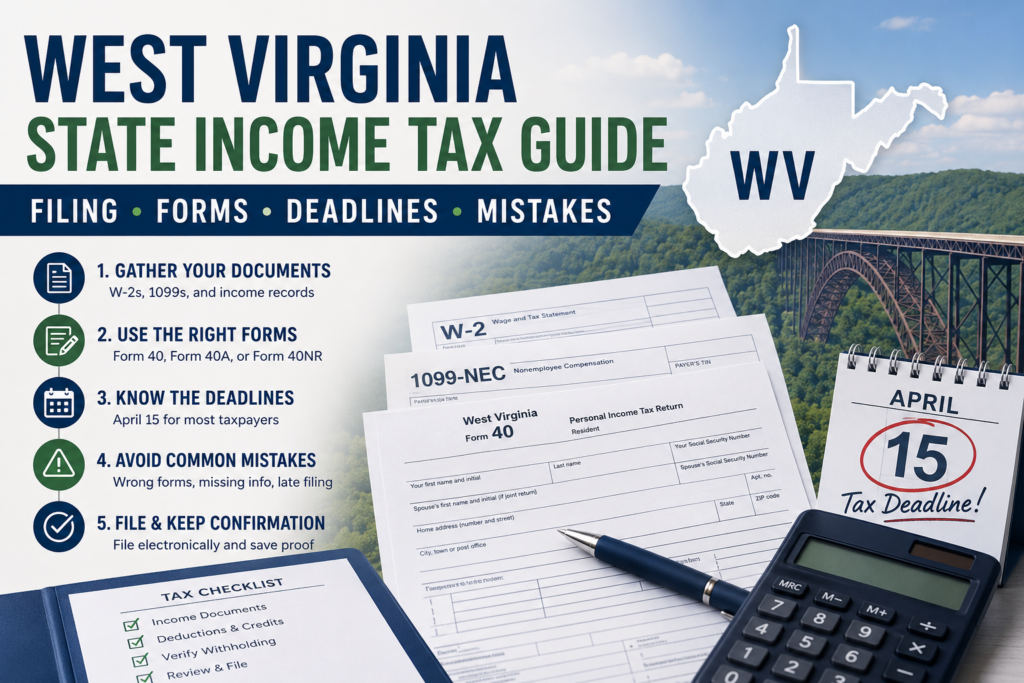
What Is West Virginia State Income Tax Filing?
West Virginia state income tax filing is the process of reporting taxable income to the state and reconciling any taxes owed or already paid through withholding or estimated payments.
For many taxpayers, the state return is connected to the federal return but is not identical to it. Filing a federal Form 1040 does not automatically satisfy state filing obligations. West Virginia uses its own forms, instructions, and filing requirements through the West Virginia State Tax Department.
Depending on the taxpayer’s situation, filing may involve:
- wage income,
- self-employment income,
- freelance or contract income,
- pass-through business income,
- withholding reconciliation,
- deductions and credits,
- nonresident or part-year resident calculations, or
- estimated tax payments.
The process becomes more complicated when someone moved during the year, worked remotely, owned a business, or earned income connected to multiple states.
Who Must File West Virginia State Income Tax?
Not every taxpayer files for the same reason, but the main groups are usually:
- full-year residents,
- part-year residents, and
- nonresidents with West Virginia-source income.
Full-Year Residents
If West Virginia was your home for the full tax year, state filing rules generally apply to your income. This can include wages, self-employment income, investment income, and certain business earnings.
Part-Year Residents
Part-year residents are people who moved into or out of West Virginia during the year. These filings often require additional attention because income may need to be allocated based on residency periods.
Nonresidents
Nonresidents may still need to file if they earned income connected to West Virginia. Examples can include:
- working physically in West Virginia,
- operating a business tied to the state,
- earning pass-through income, or
- receiving other West Virginia-source income.
Self-Employed Workers and LLC Owners
Freelancers, contractors, sole proprietors, and LLC owners should pay particular attention to state filing obligations. Business income, pass-through income, and withholding issues can create filing responsibilities even when the taxpayer assumes otherwise.
Common West Virginia Tax Forms
One of the most common filing mistakes is using the wrong form.
Form 40
Form 40 is generally associated with full-year resident individual income tax returns. Download Form 40 here.
Form 40A
Form 40A is sometimes used for simpler resident tax situations, although eligibility requirements still apply.
Form 40NR
Form 40NR generally applies to nonresidents and part-year residents who must report West Virginia-source income.
Form selection matters because the wrong form can create a chain reaction of filing mistakes involving withholding, residency calculations, credits, and reported income.
Documents You Should Gather Before Filing
Filing becomes easier when the paperwork is organized before the process begins.
A practical filing folder often includes:
- W-2 forms,
- 1099 forms,
- federal return information,
- withholding records,
- business income records,
- prior-year returns,
- estimated payment records, and
- LLC or pass-through income documentation if applicable.
If you are self-employed or own a business, organized profit-and-loss records are especially important.
One overlooked issue is withholding. Taxpayers sometimes assume enough tax was withheld without carefully checking the documents. Small withholding errors can create major refund or balance-due problems later.
How to File West Virginia State Income Tax Step by Step
Step 1: Confirm Residency Status
Before entering numbers anywhere, determine whether you are:
- a resident,
- part-year resident, or
- nonresident.
This decision affects the entire filing process.
Step 2: Gather Income Records
Collect:
- W-2s,
- 1099s,
- business records,
- federal tax forms, and
- withholding documents.
Step 3: Review West Virginia-Specific Items
Pay close attention to:
- withholding,
- deductions,
- credits,
- estimated payments, and
- business income allocation issues.
Step 4: Prepare the Return Carefully
Whether you use software or professional help, slow down and review:
- Social Security numbers,
- addresses,
- withholding amounts,
- filing status,
- payment information, and
- income totals.
Many notices begin with simple data-entry mistakes.
Step 5: File and Keep Proof
After filing:
- save copies of the return,
- preserve confirmation numbers,
- keep proof of payment, and
- maintain supporting documents.
Good records matter if questions arise later.
West Virginia Tax Deadlines and Extensions
For many taxpayers, April 15 is the standard filing deadline for calendar-year returns.
However, taxpayers should understand the difference between:
- an extension to file, and
- an extension to pay.
An extension may provide more time to submit paperwork, but unpaid balances can still accumulate penalties or interest.
Late filing can become expensive quickly. Interest and penalties may apply if taxes remain unpaid beyond the deadline.
The safest approach is to:
- estimate whether tax is owed,
- gather records early,
- create a filing plan before the deadline arrives, and
- avoid waiting until the final week.
Common West Virginia Tax Filing Mistakes
Most notices and filing problems begin with avoidable issues.
Using the Wrong Form
Choosing the wrong residency form can affect the entire return.
Missing Income Documents
A missing W-2 or 1099 can create mismatches between your filing and records already received by tax agencies.
Incorrect Withholding Entries
Simple typing errors in withholding amounts are surprisingly common.
Filing Late
Missing deadlines can trigger penalties and interest.
Ignoring Notices
Even if the state made an error, ignoring correspondence rarely helps. Prompt responses usually produce better outcomes.
Poor Recordkeeping
Taxpayers who cannot locate prior returns, payment confirmations, or source documents often struggle when problems arise.
DIY Filing vs Hiring an Accountant
Some taxpayers comfortably handle filing on their own. Others benefit from professional guidance.
DIY Filing May Work Best When:
- income is straightforward,
- records are organized,
- residency status is clear, and
- there are no major business complications.
Professional Help May Make Sense When:
- you moved states,
- you own a business,
- you have pass-through income,
- records are incomplete,
- you received notices,
- you operate an LLC, or
- multiple states are involved.
The goal is not simply to file cheaply. The goal is to file accurately.
How to Reduce the Risk of Tax Notices
A few practical habits prevent many filing problems:
- verify every income document,
- confirm withholding carefully,
- use the correct form,
- keep organized records,
- file on time,
- save confirmations, and
- respond promptly to notices.
Careful filing is almost always cheaper than reactive filing.
Frequently Asked Questions
Do I need to file if I do not owe anything?
Sometimes yes. Filing may still be necessary if West Virginia tax was withheld or if filing rules otherwise apply.
What if I moved during the year?
You may qualify as a part-year resident, which can change which form applies and how income is allocated.
What if I worked remotely?
Remote work can complicate sourcing and residency questions depending on where income was earned and where you lived.
Can LLC owners have state filing obligations?
Yes. LLC income and pass-through income can affect state filing requirements.
What happens if I file late?
Late filing can result in penalties, interest, and notices.
The Bottom Line
West Virginia state income tax filing becomes more manageable when you break it into pieces:
- determine residency,
- gather documents,
- choose the correct form,
- verify withholding,
- meet deadlines, and
- preserve records.
Most filing mistakes are not caused by complicated tax theory. They come from rushing, guessing, or failing to organize information properly.
A calm, methodical filing process reduces risk and creates a cleaner financial record going forward.
This article is for general informational purposes only and is not legal or tax advice. Tax rules, forms, deadlines, and filing obligations can change. For advice about a specific tax situation, business structure, residency issue, or filing dispute, consult a qualified tax professional or attorney.
Leave a Reply