Remote work changed how many people think about taxes. Before widespread work-from-home arrangements, state income tax questions were usually simpler. People lived in one state, worked in one state, and filed accordingly.
Now the situation can become more complicated.
A remote worker may:
- live in one state,
- work for a company based in another state,
- travel during the year,
- move mid-year,
- or perform services across multiple locations.
That raises an important question:
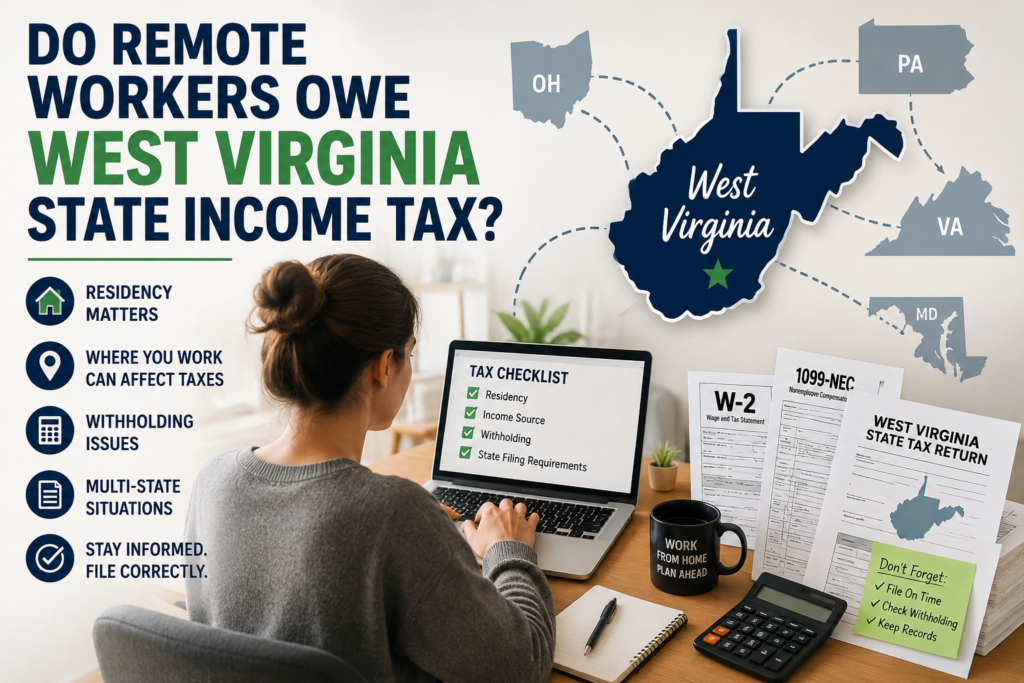
Do remote workers owe West Virginia state income tax?
The answer depends heavily on residency, where the income was earned, where the work was physically performed, and how the income is sourced.
Residency Still Matters
One of the biggest misconceptions about remote work taxes is the idea that the employer’s location automatically controls everything.
In reality, residency often matters first.
If West Virginia is your home state, you may still have West Virginia filing obligations even if:
- your employer is located elsewhere,
- you work remotely from home,
- or your company has offices in another state.
Many residents are taxed based on their overall income, not just where the employer headquarters is located.
Nonresidents Can Also Have West Virginia Filing Obligations
The reverse situation can also happen.
A person may live outside West Virginia but still owe West Virginia taxes if income is connected to work physically performed in the state.
Examples may include:
- temporary assignments,
- hybrid work arrangements,
- consulting work,
- construction projects,
- travel into West Virginia for business,
- or partial-year relocation situations.
This is where state-source income questions become important.
Remote Work Does Not Automatically Eliminate State Taxes
Some remote workers mistakenly assume:
“If I work from my laptop at home, I do not owe state taxes.”
That is not necessarily true.
State tax systems still look at:
- residency,
- sourcing,
- withholding,
- and where services were performed.
The remote nature of the work changes the analysis, but it does not erase it.
Common Remote Worker Situations
Working Remotely for an Out-of-State Employer
This is one of the most common situations.
A West Virginia resident may work remotely for:
- a company in New York,
- a tech company in California,
- a Virginia contractor,
- or a remote-first employer based elsewhere.
Even though the employer is out of state, West Virginia filing obligations may still exist because the worker resides in West Virginia.
Moving During the Year
Part-year residency situations became much more common after remote work expanded.
Examples:
- moving into West Virginia mid-year,
- leaving West Virginia during the year,
- splitting time between states,
- temporary relocations.
These situations can complicate:
- income allocation,
- residency classification,
- and filing requirements.
Freelancers and Independent Contractors
Remote freelancers and contractors often face additional complications because taxes may not be automatically withheld.
Examples include:
- consultants,
- designers,
- writers,
- developers,
- marketers,
- creators,
- and gig workers.
These taxpayers may need to think about:
- estimated taxes,
- self-employment income,
- business records,
- LLC taxation,
- and state-source income.
Withholding Problems Are Common
One practical issue remote workers encounter is incorrect withholding.
Examples may include:
- taxes withheld for the wrong state,
- no withholding at all,
- partial withholding mistakes,
- or payroll systems not updated after relocation.
This can create:
- unexpected balances due,
- refund complications,
- notices,
- or filing confusion.
That is one reason remote workers should periodically review pay stubs and withholding information rather than waiting until tax season.
Common Mistakes Remote Workers Make
Assuming the Employer Handles Everything
Payroll systems are not perfect.
Remote workers should independently verify:
- withholding,
- addresses,
- residency status,
- and state reporting.
Ignoring Multi-State Issues
Working remotely across state lines can create filing obligations in more than one jurisdiction.
Forgetting Estimated Taxes
Freelancers and contractors may need quarterly estimated payments.
Poor Recordkeeping
Moves, travel, hybrid schedules, and remote contracts create documentation issues if records are incomplete.
Assuming Online Advice Applies Universally
State tax situations can differ significantly depending on:
- residency,
- employer location,
- business structure,
- and income sourcing.
Generic internet advice is not always reliable.
Questions Remote Workers Should Ask
Before filing, remote workers should consider:
- Where did I live during the year?
- Where was the work physically performed?
- Was tax withheld correctly?
- Did I move during the year?
- Did I earn income in multiple states?
- Am I an employee or independent contractor?
- Do I need estimated tax payments?
These questions usually matter more than the phrase “remote worker” itself.
Practical Recordkeeping Tips
Remote workers should keep:
- W-2s and 1099s,
- pay stubs,
- address change records,
- move dates,
- business income records,
- withholding information,
- and prior-year returns.
Good documentation becomes especially important when multiple states are involved.
The Bottom Line
Remote work changed where many people perform services, but it did not eliminate state income tax obligations. West Virginia remote workers may still need to file state income tax returns depending on residency, income source, withholding, and where work was physically performed.
The most important thing is not to rely on assumptions. Remote work taxes can become more complicated than traditional single-state employment, especially when moves, multi-state work, freelance income, or withholding issues are involved.
This article is for general informational purposes only and is not legal or tax advice. State tax laws, residency rules, sourcing rules, and filing requirements can change. For advice about a specific remote work or multi-state tax situation, consult a qualified tax professional or attorney.
Leave a Reply