Category: LLCs

Limited liability companies (LLCs) are commonly used for small businesses, real estate holdings, consulting work, and asset separation in West Virginia. This section covers LLC formation, liability protection, taxes, lawsuits, contracts, judgment collection, compliance, and related business law issues.

  • Do Remote Workers Owe West Virginia State Income Tax?

    Remote work changed how many people think about taxes. Before widespread work-from-home arrangements, state income tax questions were usually simpler. People lived in one state, worked in one state, and filed accordingly.

    Now the situation can become more complicated.

    A remote worker may:

    • live in one state,
    • work for a company based in another state,
    • travel during the year,
    • move mid-year,
    • or perform services across multiple locations.

    That raises an important question:
    Do remote workers owe West Virginia state income tax?

    The answer depends heavily on residency, where the income was earned, where the work was physically performed, and how the income is sourced.

    Residency Still Matters

    One of the biggest misconceptions about remote work taxes is the idea that the employer’s location automatically controls everything.

    In reality, residency often matters first.

    If West Virginia is your home state, you may still have West Virginia filing obligations even if:

    • your employer is located elsewhere,
    • you work remotely from home,
    • or your company has offices in another state.

    Many residents are taxed based on their overall income, not just where the employer headquarters is located.


    Nonresidents Can Also Have West Virginia Filing Obligations

    The reverse situation can also happen.

    A person may live outside West Virginia but still owe West Virginia taxes if income is connected to work physically performed in the state.

    Examples may include:

    • temporary assignments,
    • hybrid work arrangements,
    • consulting work,
    • construction projects,
    • travel into West Virginia for business,
    • or partial-year relocation situations.

    This is where state-source income questions become important.


    Remote Work Does Not Automatically Eliminate State Taxes

    Some remote workers mistakenly assume:

    “If I work from my laptop at home, I do not owe state taxes.”

    That is not necessarily true.

    State tax systems still look at:

    • residency,
    • sourcing,
    • withholding,
    • and where services were performed.

    The remote nature of the work changes the analysis, but it does not erase it.


    Common Remote Worker Situations

    Working Remotely for an Out-of-State Employer

    This is one of the most common situations.

    A West Virginia resident may work remotely for:

    • a company in New York,
    • a tech company in California,
    • a Virginia contractor,
    • or a remote-first employer based elsewhere.

    Even though the employer is out of state, West Virginia filing obligations may still exist because the worker resides in West Virginia.
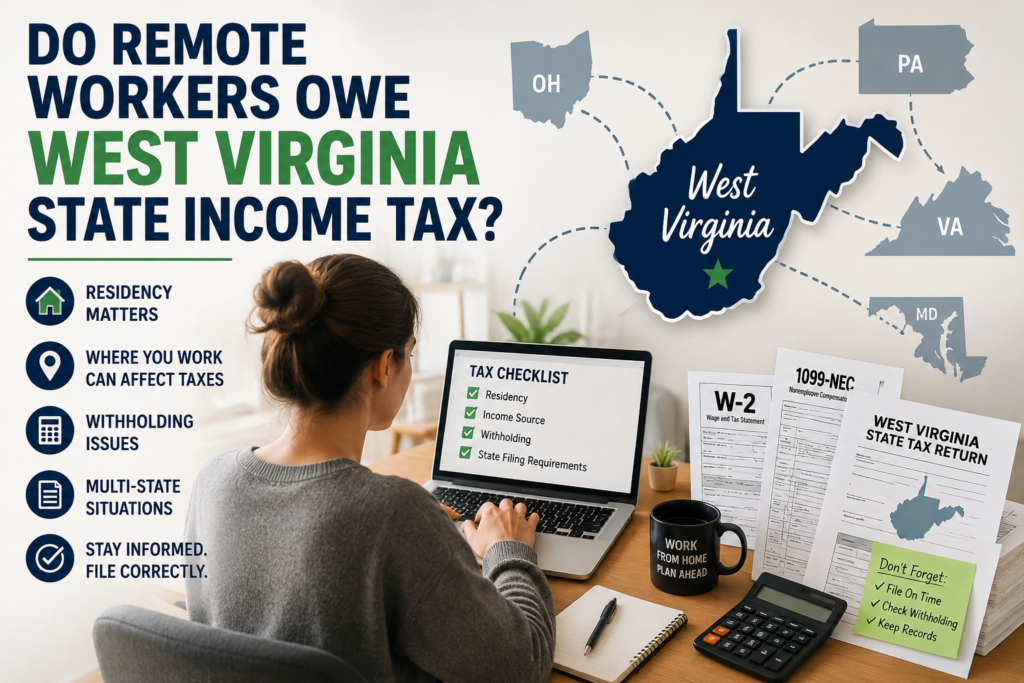
    WV Remote Workers

    Moving During the Year

    Part-year residency situations became much more common after remote work expanded.

    Examples:

    • moving into West Virginia mid-year,
    • leaving West Virginia during the year,
    • splitting time between states,
    • temporary relocations.

    These situations can complicate:

    • income allocation,
    • residency classification,
    • and filing requirements.

    Freelancers and Independent Contractors

    Remote freelancers and contractors often face additional complications because taxes may not be automatically withheld.

    Examples include:

    • consultants,
    • designers,
    • writers,
    • developers,
    • marketers,
    • creators,
    • and gig workers.

    These taxpayers may need to think about:

    • estimated taxes,
    • self-employment income,
    • business records,
    • LLC taxation,
    • and state-source income.

    Withholding Problems Are Common

    One practical issue remote workers encounter is incorrect withholding.

    Examples may include:

    • taxes withheld for the wrong state,
    • no withholding at all,
    • partial withholding mistakes,
    • or payroll systems not updated after relocation.

    This can create:

    • unexpected balances due,
    • refund complications,
    • notices,
    • or filing confusion.

    That is one reason remote workers should periodically review pay stubs and withholding information rather than waiting until tax season.


    Common Mistakes Remote Workers Make

    Assuming the Employer Handles Everything

    Payroll systems are not perfect.

    Remote workers should independently verify:

    • withholding,
    • addresses,
    • residency status,
    • and state reporting.

    Ignoring Multi-State Issues

    Working remotely across state lines can create filing obligations in more than one jurisdiction.


    Forgetting Estimated Taxes

    Freelancers and contractors may need quarterly estimated payments.


    Poor Recordkeeping

    Moves, travel, hybrid schedules, and remote contracts create documentation issues if records are incomplete.


    Assuming Online Advice Applies Universally

    State tax situations can differ significantly depending on:

    • residency,
    • employer location,
    • business structure,
    • and income sourcing.

    Generic internet advice is not always reliable.


    Questions Remote Workers Should Ask

    Before filing, remote workers should consider:

    • Where did I live during the year?
    • Where was the work physically performed?
    • Was tax withheld correctly?
    • Did I move during the year?
    • Did I earn income in multiple states?
    • Am I an employee or independent contractor?
    • Do I need estimated tax payments?

    These questions usually matter more than the phrase “remote worker” itself.


    Practical Recordkeeping Tips

    Remote workers should keep:

    • W-2s and 1099s,
    • pay stubs,
    • address change records,
    • move dates,
    • business income records,
    • withholding information,
    • and prior-year returns.

    Good documentation becomes especially important when multiple states are involved.


    The Bottom Line

    Remote work changed where many people perform services, but it did not eliminate state income tax obligations. West Virginia remote workers may still need to file state income tax returns depending on residency, income source, withholding, and where work was physically performed.

    The most important thing is not to rely on assumptions. Remote work taxes can become more complicated than traditional single-state employment, especially when moves, multi-state work, freelance income, or withholding issues are involved.

    This article is for general informational purposes only and is not legal or tax advice. State tax laws, residency rules, sourcing rules, and filing requirements can change. For advice about a specific remote work or multi-state tax situation, consult a qualified tax professional or attorney.
  • Do LLC Owners and Self-Employed Workers Have to File West Virginia Taxes?

    A lot of people assume that forming an LLC changes whether they personally file taxes. In reality, the answer is usually more complicated. The business structure affects how income is reported, but it does not automatically eliminate state tax filing obligations.

    For many LLC owners, freelancers, contractors, consultants, and self-employed workers, West Virginia tax filing can still apply even when the business itself is separate from the owner for liability purposes.

    The key issue is understanding how the income flows and how West Virginia treats different business structures.

    The Short Answer

    Many LLC owners and self-employed workers may still need to file West Virginia state income tax returns.

    That can include:

    • sole proprietors,
    • single-member LLC owners,
    • multi-member LLC members,
    • independent contractors,
    • freelancers,
    • consultants,
    • gig workers, and
    • pass-through business owners.

    The analysis depends on factors such as:

    • residency,
    • where the income was earned,
    • business structure,
    • pass-through income,
    • withholding,
    • and whether West Virginia-source income exists.

    Sole Proprietors and Self-Employed Workers

    Many self-employed workers operate as sole proprietors, even if they never formally created an LLC.

    In that structure, business income and expenses are commonly reported through the owner’s personal tax return. The income does not stay isolated from the individual taxpayer simply because the work was freelance or independent.

    Examples may include:

    • consulting work,
    • graphic design,
    • rideshare driving,
    • online selling,
    • contract labor,
    • photography,
    • home services,
    • content creation, or
    • side-business income.

    If the work produced taxable income connected to West Virginia, state filing obligations may apply.


    Single-Member LLCs

    A single-member LLC is one of the most misunderstood structures.

    People often assume:

    “I formed an LLC, so the business files separately and I personally do not.”

    That is not always how taxation works.

    Many single-member LLCs are treated as “disregarded entities” for tax purposes. In practical terms, the income often still flows through to the owner’s personal return.

    That means the owner may still report:

    • profits,
    • losses,
    • deductions,
    • and business income

    on their individual filing.

    The LLC may provide liability protection, but the tax reporting can still connect directly to the individual taxpayer.


    Multi-Member LLCs

    Multi-member LLCs often operate differently.

    Instead of being treated like sole proprietorships, they are commonly taxed more like partnerships unless another tax election was made.

    In those situations:

    • the LLC may file an informational return,
    • members may receive K-1 forms,
    • and each member may report their share of income individually.

    This is where things can become more complicated, especially when:

    • members live in different states,
    • income comes from multiple jurisdictions,
    • or pass-through income allocation becomes involved.

    LLCs That Elect S-Corporation Tax Treatment

    Some LLCs elect S-corporation tax treatment for federal tax purposes.

    That can change how compensation and distributions are handled.

    In these structures, issues may include:

    • payroll,
    • withholding,
    • owner compensation,
    • distributions,
    • and business accounting.

    This is one reason many growing businesses eventually move beyond simple DIY bookkeeping.


    Nonresident LLC Owners

    A person can live outside West Virginia and still have West Virginia tax obligations.

    For example, a nonresident LLC owner may still need to file if:

    • the LLC generated West Virginia-source income,
    • the business operated in West Virginia,
    • or pass-through income was connected to the state.

    This area creates confusion because many people assume residency alone controls everything. In reality, income sourcing can matter just as much.


    Estimated Taxes and Quarterly Payments

    Self-employed workers and LLC owners often do not have taxes automatically withheld the same way traditional employees do.

    That creates another common issue:
    underpayment.

    Some taxpayers may need to make estimated tax payments during the year rather than waiting until filing season.

    Failing to plan for taxes throughout the year can lead to:

    • unexpected balances due,
    • penalties,
    • interest,
    • and cash flow problems.

    Common Mistakes LLC Owners Make

    Assuming the LLC Eliminates Personal Filing Obligations

    An LLC can affect liability protection without eliminating personal tax reporting.

    Mixing Personal and Business Records

    Poor bookkeeping creates filing problems quickly.

    Ignoring Estimated Taxes

    Waiting until April to think about taxes can become expensive.

    Assuming Online Advice Applies Universally

    Business taxation depends heavily on:

    • entity elections,
    • residency,
    • income source,
    • and business activity.

    A TikTok video or forum comment is not a substitute for understanding your actual structure.

    Forgetting State-Level Rules

    Federal filing and state filing are related, but they are not identical.


    Practical Questions to Ask

    Before filing, LLC owners and self-employed workers should ask:

    • Where was the income earned?
    • What business structure am I using?
    • Did I elect special tax treatment?
    • Was tax withheld?
    • Do I have pass-through income?
    • Do I need estimated payments?
    • Is my bookkeeping organized?

    These questions often matter more than the LLC label itself.


    DIY vs Professional Help

    Some self-employed workers can comfortably handle filing on their own.

    Others may benefit from professional help, especially when:

    • multiple states are involved,
    • business income is growing,
    • payroll exists,
    • pass-through income becomes complicated,
    • or records are incomplete.

    The goal is not simply to file cheaply. The goal is to file accurately and consistently.


    The Bottom Line

    Forming an LLC does not automatically remove personal tax filing obligations in West Virginia. Many LLC owners and self-employed workers still report income through their individual tax returns, especially in pass-through structures.

    The real issue is not simply whether an LLC exists. The issue is how the business is taxed, where the income was earned, and how the income flows through to the owner.

    Good recordkeeping, organized filing, and understanding your structure early can prevent much bigger problems later.

    This article is for general informational purposes only and is not legal or tax advice. Tax laws, filing obligations, entity rules, and residency issues can change. For advice about a specific business structure, LLC election, or filing obligation, consult a qualified tax professional or attorney.

  • Multiple LLCs and Judgment Collection in West Virginia: Red Flag or Normal Business Practice?

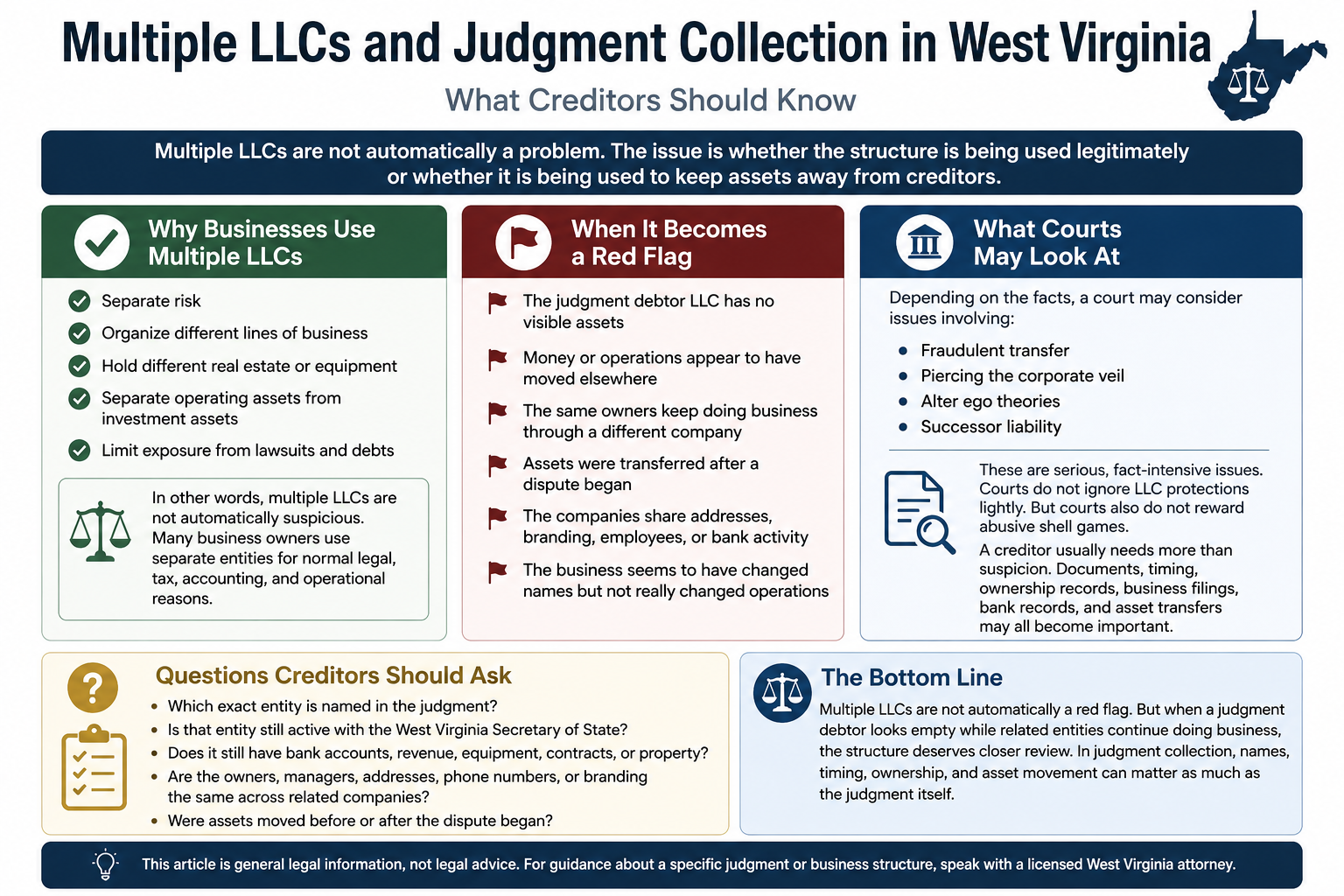
    It is common for a business owner to use more than one LLC. In many situations, that is ordinary business planning. Separate entities may be used to hold different assets, manage risk, or operate different lines of business.

    But if you are trying to collect on a judgment, multiple LLCs can raise difficult questions. The issue is not simply whether there are several entities. The issue is whether the structure is being used legitimately or whether it is being used to keep assets away from creditors.

    Multiple LLCs WV

    Why Businesses Use Multiple LLCs

    Separate entities are often created to:

    • separate risk
    • organize different lines of business
    • hold different real estate or equipment
    • separate operating assets from investment assets, or
    • limit exposure from lawsuits and debts

    In other words, multiple LLCs are not automatically suspicious. Many business owners use separate entities for normal legal, tax, accounting, and operational reasons.

    When It Becomes a Red Flag

    The concern grows when the entity that lost the lawsuit appears empty while related entities continue operating. Red flags may include:

    • the judgment debtor LLC has no visible assets,
    • money or operations appear to have moved elsewhere,
    • the same owners keep doing business through a different company,
    • assets were transferred after a dispute began,
    • the companies share addresses, branding, employees, or bank activity, or
    • the business seems to have changed names but not really changed operations.

    That is when people start wondering whether the structure was used to make the business judgment-proof.

    What Courts May Look At

    Depending on the facts, a court may consider issues involving fraudulent transfer, piercing the corporate veil, alter ego theories, or successor liability. These are serious, fact-intensive issues. Courts do not ignore LLC protections lightly. But courts also do not reward abusive shell games.

    The details matter. A creditor usually needs more than suspicion. Documents, timing, ownership records, business filings, bank records, and asset transfers may all become important.

    Questions Creditors Should Ask

    If you are trying to understand whether multiple LLCs matter, start with practical questions:

    • Which exact entity is named in the judgment?
    • Is that entity still active with the West Virginia Secretary of State?
    • Does it still have bank accounts, revenue, equipment, contracts, or property?
    • Are the owners, managers, addresses, phone numbers, or branding the same across related companies?
    • Were assets moved before or after the dispute began?

    Those details may matter more than the number of LLCs alone.

    Why This Matters in Collection

    People often assume winning a lawsuit means the hard part is over. But sometimes the real problem begins after judgment, especially when the debtor operates through layered business entities.

    That is one reason many people start with the broader question: Can someone avoid paying a judgment? You may also want to understand the difference between a judgment itself and a property claim by reading Judgment vs. Lien in West Virginia.

    The Bottom Line

    Multiple LLCs are not automatically a red flag. But when a judgment debtor looks empty while related entities continue doing business, the structure deserves closer review. In judgment collection, names, timing, ownership, and asset movement can matter as much as the judgment itself.

    This article is general legal information, not legal advice. For guidance about a specific judgment or business structure, speak with a licensed West Virginia attorney.

  • West Virginia Business License (2026): Do You Need One + How to Get It

    If you’re starting a business in West Virginia, one of the most common—and confusing—questions is:

    “Do I actually need a business license?”

    The short answer is:

    👉 Yes — most businesses need more than one.

    There is no single, universal business license in West Virginia.
    Instead, your requirements depend on:

    • What your business does
    • Where it operates
    • Whether you sell goods or taxable services
    • Whether your profession is regulated

    👉 Important:
    Forming an LLC or corporation does NOT mean you are licensed to operate.
    That’s one of the most common (and costly) mistakes new business owners make.


    What Counts as a “Business License” in West Virginia?

    In West Virginia, “business license” is really an umbrella term that includes:

    • State business registration (LLC, corporation, or DBA)
    • Sales tax registration
    • Local city or county business licenses
    • Professional or occupational licenses
    • Industry-specific permits (health, construction, etc.)

    👉 Most businesses need a combination of these—not just one.

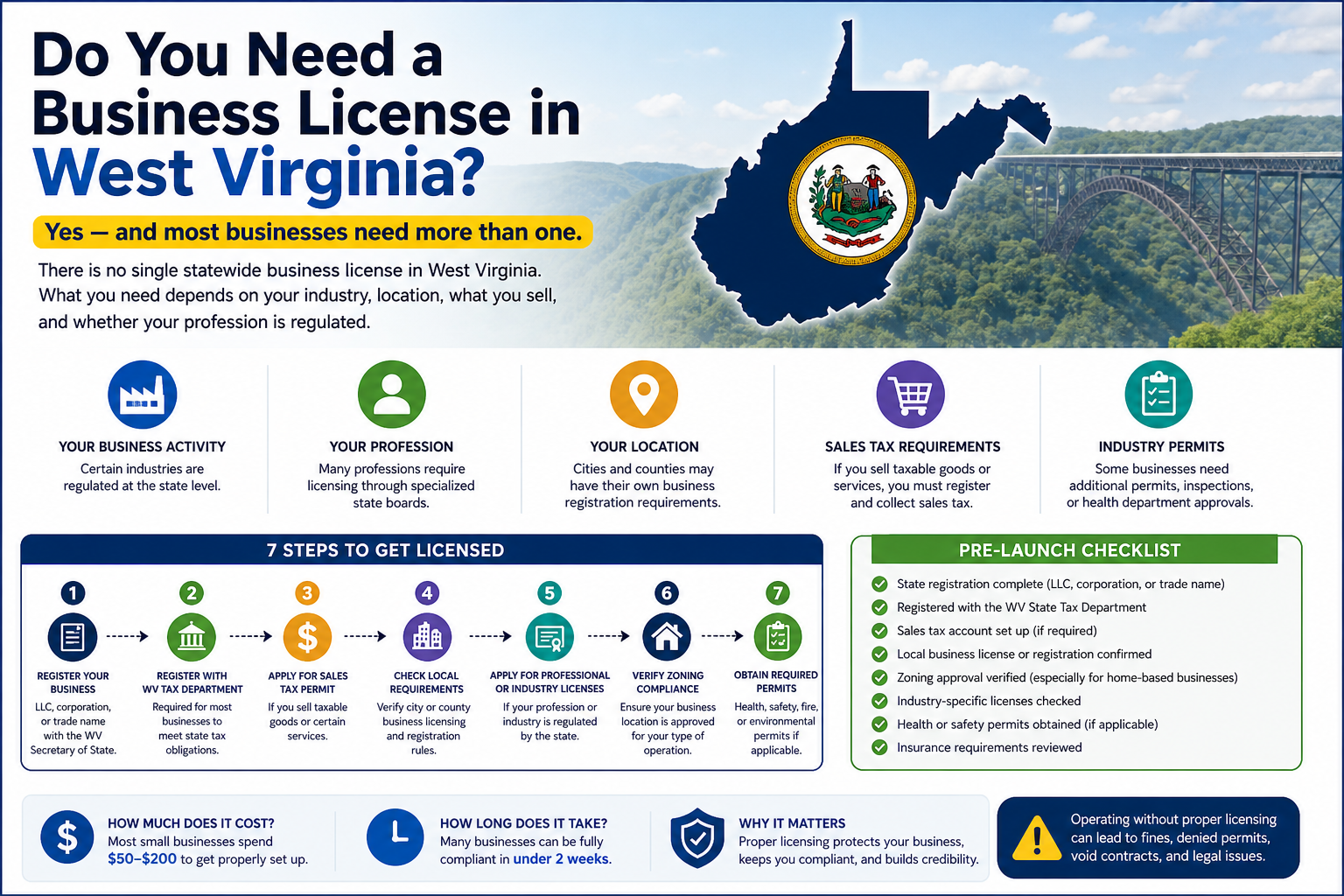
    wv business license


    How to Get a Business License in West Virginia (Step-by-Step)

    If you want to be fully compliant, here’s the process most businesses follow:

    Step 1: Register Your Business

    • Form an LLC, corporation, or register a trade name
    • Filed through the West Virginia Secretary of State

    👉 This creates your legal entity—but does NOT license your activity.


    Step 2: Register with the WV State Tax Department

    • Required for most businesses
    • Needed to pay business taxes and hire employees

    👉 This step connects your business to the state’s tax system.


    Step 3: Apply for a Sales Tax Permit (if applicable)

    If you sell:

    • Physical goods
    • Certain taxable services

    You must:

    • Register for a sales tax account
    • Collect and remit sales tax

    👉 This applies to both in-state and out-of-state sellers.


    Step 4: Check Local City or County Requirements

    Many cities require their own registration.

    Common examples include:

    • Charleston
    • Huntington
    • Morgantown

    👉 Local requirements vary—always verify with your city or county clerk.


    Step 5: Apply for Industry or Professional Licenses

    If you work in a regulated field, you may need licensing from a state board.

    Common examples:

    • Contractors
    • Real estate agents
    • Cosmetologists
    • Accountants
    • Healthcare professionals

    👉 These are issued by professional boards—not a central office.


    Step 6: Verify Zoning Compliance

    Especially important for:

    • Home-based businesses
    • Retail or service locations

    👉 Local zoning laws can restrict what you’re allowed to do at a specific property.


    Step 7: Obtain Permits (if required)

    Depending on your business, you may need:

    • Health permits
    • Fire/safety inspections
    • Environmental approvals

    👉 These are common in food service, construction, and manufacturing.


    How Much Does a Business License Cost in West Virginia?

    Costs vary, but most businesses fall into these ranges:

    • State registration (LLC or business): $30–$100
    • Sales tax registration: Free
    • Local business license: $15–$100+
    • Professional licenses: $50–$300+

    👉 Typical total: $50–$200 for many small businesses
    (More for regulated industries)


    How Long Does It Take?

    • Online registrations: Same day to 1–2 weeks
    • Local approvals: A few days to a few weeks
    • Regulated industries: Longer (inspections or board review)

    👉 Many small businesses can be fully compliant in under 2 weeks.


    What Determines What Licenses You Need?

    There’s no one-size-fits-all answer. It depends on four key factors:


    1. Your Business Activity

    Certain industries are regulated at the state level.

    Examples:

    • Construction
    • Food service
    • Healthcare
    • Transportation

    👉 These industries almost always require additional licensing.


    2. Your Profession

    West Virginia licenses many professions through specialized boards.

    Examples include:

    • Lawyers
    • Doctors
    • Real estate agents
    • Engineers
    • Accountants

    👉 These licenses are separate from general business registration.


    3. Your Location (City or County)

    Local governments may require:

    • Business registration
    • Local licensing
    • Annual renewal fees

    👉 Requirements can vary significantly between locations.


    4. Sales Tax Requirements

    If you sell taxable goods or services, you must:

    • Register with the WV State Tax Department
    • Collect and remit sales tax

    👉 This applies even to online businesses.


    Common Business Types (What They Typically Need)

    🍔 Food & Beverage Businesses

    • Health department permits
    • Inspections before opening
    • Local approvals

    👉 Restaurants, food trucks, and bakeries face stricter requirements.


    🔨 Contractors & Construction

    • Licensed through the WV Division of Labor
    • May require bonding and insurance

    👉 Operating without a license can:

    • Void contracts
    • Expose you to legal liability

    🛍️ Retail & E-Commerce

    • Sales tax registration
    • Local licensing (in some areas)

    👉 Applies even if you sell online or ship into West Virginia.


    🏠 Home-Based Businesses

    • Zoning approval may be required
    • Local restrictions may apply

    👉 Many people skip this—and run into problems later.


    🧑‍⚕️ Licensed Professions

    • State board licensing required

    Fields include:

    • Law
    • Medicine
    • Real estate
    • Engineering

    👉 You cannot legally operate without proper licensing.


    Example: What a Real Business Needs

    Example: Starting a Landscaping Business

    You may need:

    • LLC registration
    • WV tax registration
    • Contractor license (depending on scope)
    • Local city registration
    • Sales tax account (if selling materials)

    👉 This is why there’s no single license—it’s a layered system.


    Common Mistakes to Avoid

    Many new business owners run into issues by:

    • Thinking an LLC = a business license
    • Forgetting local registration requirements
    • Skipping sales tax setup
    • Ignoring zoning laws
    • Operating without required professional licenses

    👉 These mistakes can lead to:

    • Fines
    • Denied permits
    • Invalid contracts
    • Insurance issues

    What Happens If You Don’t Have the Right Licenses?

    This is where things get serious.

    Operating without proper licensing can result in:

    • Civil penalties and fines
    • Business shutdown orders
    • Contracts that are unenforceable
    • Loss of legal protection
    • Insurance claim denials

    👉 In some cases, you may also face retroactive penalties.


    Why This Matters More Than You Think

    Proper licensing affects more than compliance—it impacts your entire business:

    • Banks may deny accounts or loans
    • Landlords may refuse leases
    • Customers may question credibility
    • You may lose legal protection in disputes

    👉 Getting this right early is one of the highest ROI decisions you can make.


    The One Question to Ask Yourself

    Before launching your business, ask:

    “If someone reviewed my business today, would everything check out?”

    If the answer isn’t clear—verify now, not later.


    Frequently Asked Questions

    Do I need a business license if I have an LLC in West Virginia?

    Yes. An LLC is a legal structure—not a license to operate.


    Do online businesses need a West Virginia license?

    Yes, if you sell to customers in West Virginia or have a business presence in the state.


    Can I run a business from home?

    Sometimes—but you must check local zoning laws first.


    Do all businesses need to collect sales tax?

    No—but if you sell taxable goods or services, you must register and collect it.


    Where do I find my specific requirements?

    Start with the WV One Stop Business Center, then verify with:


    Final Thoughts

    Most businesses in West Virginia need multiple approvals—not just one license.

    The key is simple:

    • Understand your requirements
    • Verify with the right agencies
    • Get compliant before you operate

    👉 A few hours of setup now can save you months of legal and financial problems later.


    Last reviewed: May 2026
    Licensing requirements can change—always confirm with the appropriate state or local agency.